
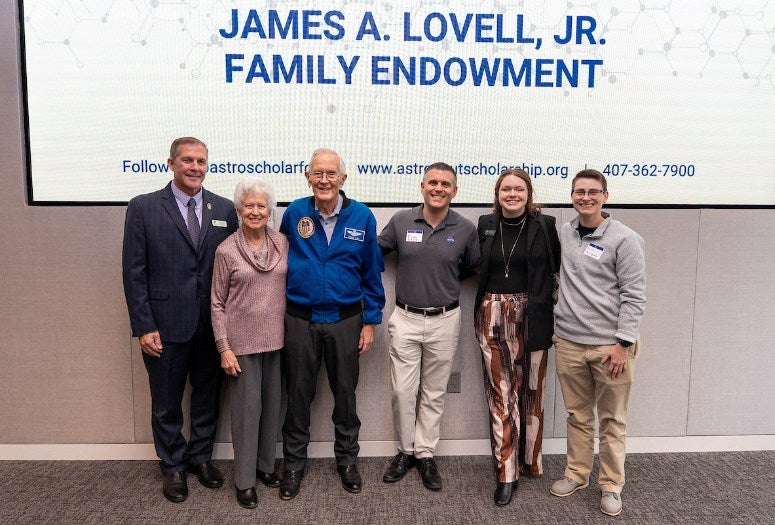
Ambition is sky-high at Rice University, and a recently announced partnership will make humankind’s endeavors to explore the unknown an even closer possibility. The Center for Civic Learning (CCL) and the Rice Space Institute hosted the Astronaut Scholarship Foundation (ASF) to learn about the prestigious Astronaut Scholarship, which offers students up to $15,000, mentorship, networking and a paid trip to the ASF Innovators Symposium and Gala. Starting this spring, the Astronaut Scholarship is newly opened to Rice junior or senior STEM majors.
Students, employees and community members gathered in the Ralph S. O’Connor Building for Engineering and Science to meet ASF representatives, including the family of late astronaut James Lovell. The scholarship for Rice students is specifically funded by the James A. Lovell Jr. Family Endowment. They also met in anticipation to hear from famed astronaut Charlie Duke at this special occasion.
David Alexander, professor of physics and astronomy and director of the Rice Space Institute, emceed the event, welcoming each guest of honor to share a few words. Janet Braam, associate dean for strategic initiatives, and Maria Oden, director of the Oshman Engineering Design Kitchen and co-director of the Rice360 Institute for Global Health Technologies, warmed up the crowd by expressing their excitement and support for the partnership before Bridget Gorman, vice provost for student life, dean of undergraduates and Trustee Professor of Sociology, took to the podium.
Gorman noted how well Rice students and the ASF are aligned when it comes to broadening opportunities.
“I’m continually amazed by [Rice students’] excitement for taking advantage of all the different opportunities that come their way,” Gorman said, reflecting on her 24 years at Rice. “Many of them can show up with a clear focus on what they want to do and how they think their career is going to unfold. [I have also seen] how many of them suddenly take a turn to the right or to the left because of a mentor or an opportunity or finding a community they never imagined they could join prior to coming to Rice.”
She was followed by Danika Brown, executive director of the CCL, who said, “Rice students have access to the highest caliber academic and research experiences, but as you’ve heard here tonight, they also have support and access to programming that allows them to apply their research and skills to pressing issues in the community, developing as leaders committed to public purpose.
“This scholarship opportunity represents an exciting new avenue for Rice STEM students to synthesize their experiences in courses and research and their commitment to advancing the public good as leaders in their field. We are so grateful to the Lovell family and to the foundation for investing in Rice students, and we are confident that the foundation will be impressed with our nominees and that selected students will have a life-changing experience as astronaut scholars.”
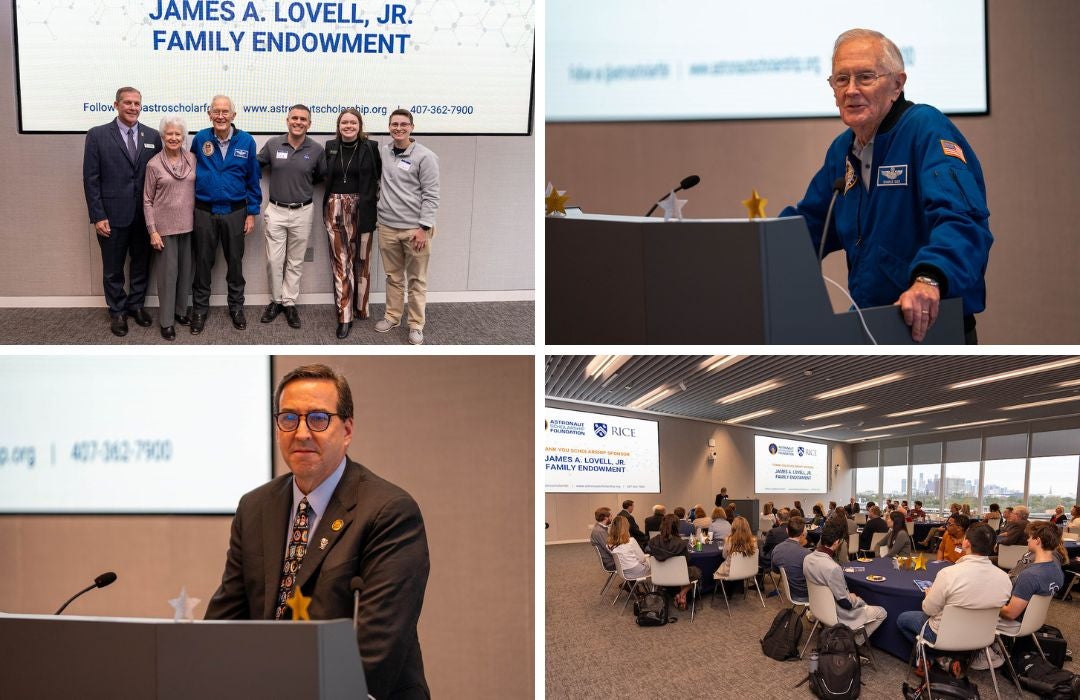
Jeff Lovell — the son of legendary NASA astronaut James Lovell, who commanded Apollo 13, flew on Apollo 8 and is one of the ASF founders — then took the podium to share his happiness of seeing his father’s work continuing in partnership with Rice.
“As you have heard, the Astronaut Scholarship Foundation was created back in 1984 by the original Mercury 7 astronauts with a shared goal to help maintain U.S. leadership in technology and innovation by supporting exceptional university students in the fields of science, technology, engineering and mathematics,” Jeff Lovell said. “Our father, NASA astronaut Capt. James Lovell, was a passionate and unwavering advocate for the mission of the Astronaut Scholarship Foundation. On behalf of my siblings and the entire Lovell family, we are delighted to be here at Rice University to announce a new partnership between the astronaut Scholarship Foundation and Rice University.”
Finally, it was Duke’s chance to talk, and he recounted some stories from his career and opportunities to walk on the moon.
“We spent three days in the lunar highlands, exploring the highland area,” he said. “We are the only flight that went to the highlands of the moon, or the mountains of the moon as they are sometimes called. If you look at where Neil Armstrong landed, we landed in an 8,000 feet difference in elevation. The moon is hilly just like Earth, and our rover revolutionized the lunar exploration.”
He also explained the timing of the Apollo mission.
“Apollo was a 72-hour trip to the moon, and that was designed for this fuel budget we had in the command module,” he said. “We had enough fuel when we got there to slow down, go into orbit, maneuver in orbit and enough fuel to get us back out of orbit and on the way home. So that’s why it took 72 hours. You can go straight to the moon in 12 hours, but you’re going so fast when you get there, and we didn’t have enough fuel.”
He brought up his experience with the “overview effect,” which is when astronauts go through an overwhelming sense of connection to humanity and the planet, realizing that the Earth is a shared, fragile home without borders.
“It was breathtaking; Earth was just suspended in the blackness of space,” he said. “It was just incredible. I just sat there looking out the window of the ship and seeing the western United States and down across Mexico, Central America. On the land masses you see in that part … you can see there the Rocky Mountains.”
The event was sponsored by the CCL and the Rice Space Institute.
Students interested in learning more about the scholarship or applying should reach out to the CCL.