
Long before rockets, satellites or space stations, humans were already in a relationship with outer space. People looked up and named constellations. They told stories about the moon. They wrote poems, mapped stars and built myths around lights in the sky they could not touch. Across cultures and centuries, outer space functioned as more than a scientific mystery; it was a mirror for human longing, fear, imagination and hope.
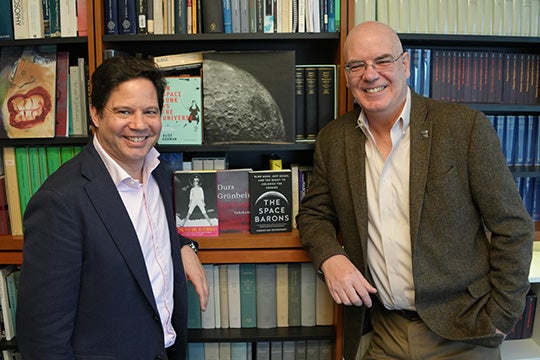
As NASA prepares for the launch of Artemis II — the first crewed mission around the moon in more than 50 years — two Rice University scholars are asking what it would mean to treat that long human relationship with space as not just a footnote to engineering but as a central intellectual pursuit.
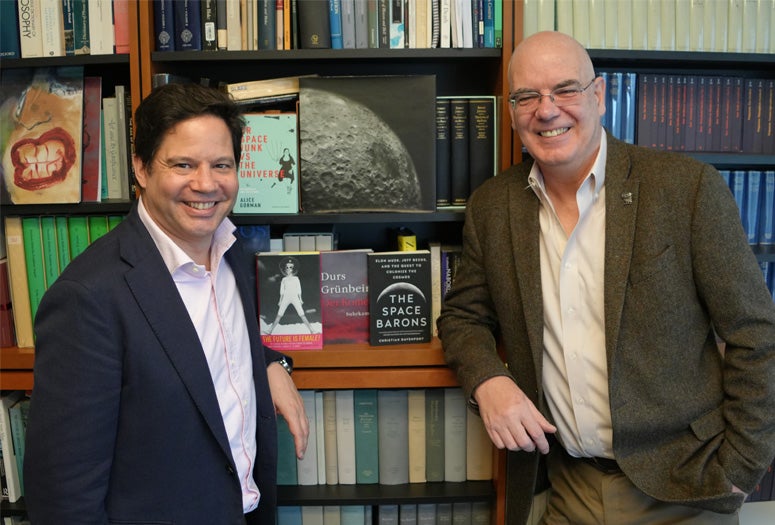
That question became the foundation of Rice’s new Space Humanities Initiative, a collaboration between Alexander Regier, the William Faulkner Professor of English and chair of the Department of English and Creative Writing, and David Alexander, director of the Rice Space Institute and professor of physics and astronomy. The initiative brings together scholars across disciplines to examine how space exploration both shapes and is shaped by culture, language, ethics, history and imagination. At a moment when space is increasingly framed through technological competition, commercial opportunity and geopolitical power, the initiative insists on a different starting point.
“Space is really just the canvas,” Alexander said. “When we talk about space, it’s usually in relation to people. It’s a people issue.”
The Space Humanities Initiative recently received support from the Office of Research, which provides seed funding for unconventional, early stage projects with the potential to grow into large-scale external grant proposals. Regier and Alexander’s long-term goal is to develop a proposal for a permanent Center for Space Humanities at Rice.
The work will extend beyond any single department or methodology. Planned activities include interdisciplinary workshops, visiting scholars, public programs and collaborations with Houston institutions such as NASA, the Museum of Fine Arts, Houston and Villa Albertine. The initiative also builds on Rice’s historical connection to space exploration, including former President John F. Kennedy’s 1962 “We choose to go to the moon” speech delivered on campus.
One of the initiative’s central concerns is how inherited language quietly carries assumptions into the future, even when those assumptions no longer reflect contemporary values.
“We used to talk about ‘manned spaceflight,’” Alexander said. “Now we use ‘crewed spaceflight’ because we’re recognizing the biases in the language.”
Questions about ownership, settlement, commercial use and planetary responsibility raise similar issues. Words that once seemed neutral acquire new weight as humanity moves closer to sustained off-world presence. Rather than expecting scientists and engineers to independently resolve these tensions, the initiative is designed to create sustained spaces where such questions can be confronted collectively.
“You create a space rather than complaining that the people who are building the fuel tanks on the rockets aren’t thinking about ethics,” Regier said. “We want to build a space where that kind of exchange and thinking can thrive.”
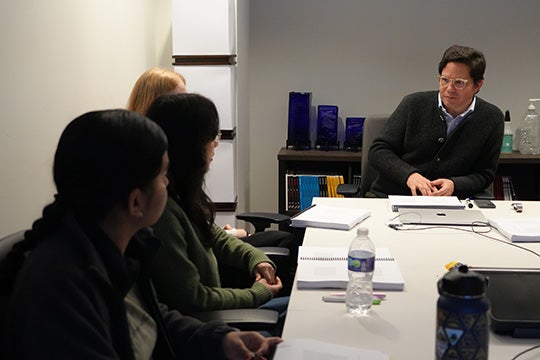
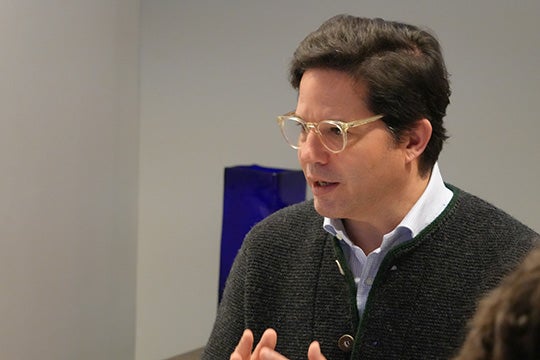
The classroom is one of the initiative’s earliest laboratories. Regier’s course Outer Space and the Humanities brings together students from across majors to explore space through literature, art, music, science, medicine, social science and ethical inquiry. Students arrive with widely different technical backgrounds, but many share a similar realization once the course begins: They have been thinking about space in humanistic ways for much of their lives, even if they never labeled it as such.
“I was interested in ENGL 199 because I’m a huge science fiction fan,” said Bridget Hale, a senior studying computational and applied math as well as statistics. “I think that there’s a lot to be learned about the past and the future from sci-fi and the intersection of STEM, and the humanities creates a very broad opportunity to explore these concepts.”
For other students, the course has reshaped how they think about their futures.
“I’ve completed many technical subjects that cover how we go to space, but this is the first subject that has questioned why,” said graduate student Margot Moy, who added she’s always wanted to work in the space industry. “I hope that a greater understanding of what space means to humans, both myself and others, will guide ethical career choices.”
Some students are using the course to interrogate how human bodies and identities are constructed within spaceflight narratives.
“Specifically, I want to answer questions such as: How have bodily standards, race, gender and ethics shaped who is considered ‘fit’ for space travel over time? How do different narratives depict humans’ physical and psychological relationship with the risks of space exploration?” said Sashi Kulatilaka, a sophomore majoring in biochemistry.
While the initiative is still in its early stages, Regier and Alexander view it as an incubator for a much larger intellectual structure, one that is capable of reshaping how universities think about space itself.
“The ultimate ambition is to change the thinking in these fields to such a degree that it will be impossible to think about space exploration without concretely considering its cultural and humanistic dimensions,” Regier said.
For a species that has always looked upward, the Space Humanities Initiative begins with a simple premise: Wherever humans go, interpretation follows.