
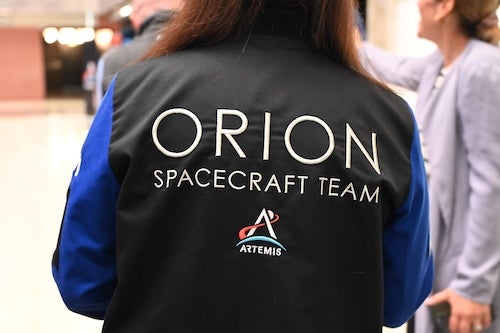
At her first speaking engagement since NASA’s successful Artemis II mission, engineer Branelle Rodriguez shared what it took to ready the spacecraft that carried humans around the moon for the first time in over half a century, returned them home safely and ultimately brought humanity farther from Earth than ever before at an event held at the Ion, Houston’s innovation district powered by Rice University
“NASA Stories at the Ion” is a morning series that spotlights the human side of space exploration with each session featuring personal and powerful stories from astronauts and key NASA personnel.
Orion, the only spacecraft capable of crewed deep space flight and high-speed reentry from the vicinity of the moon, completed its Artemis II crewed test flight April 10 to confirm its systems performed as designed in the real environment of deep space. The 694,481-mile journey is the farthest distance humans have traveled from Earth.
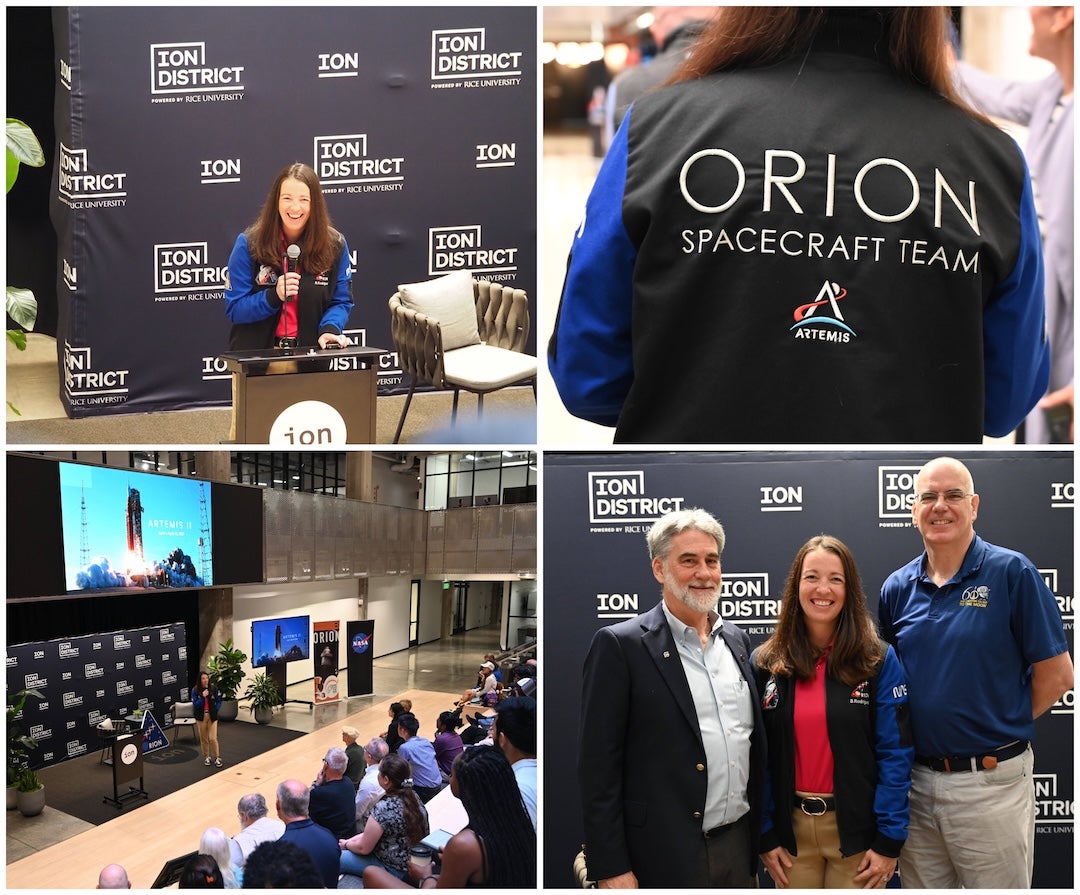
As Artemis II Orion vehicle manager and manager of program integration, Rodriguez’s role focused on overseeing the end-to-end development and production of the spacecraft and providing program leadership for integration as well as mission execution. She’s been in “24/7 operations” since May 2025 after her team handed the vehicle over for processing, where every aspect of the ship is tested.
Rodriguez has gained extensive expertise in spaceflight through her leadership of development projects and integration initiatives since she started at NASA in 2004. Before her tenure with the Orion program, she managed on-orbit engineering for the International Space Station (ISS) in the ISS Program Office. In that capacity, she directed the ISS Mission Evaluation Room (MER), where she played a vital role in integrating MER activities with program and vehicle office management to resolve technical anomalies and oversee operations. Her career within the ISS MER involved leading investigation teams for real-time flight issues, managing technical disciplines during visiting vehicle integration and collaborating with international partners on daily station operations.
She shared how several different parts have to align perfectly to make a successful launch, so it was a surprise that Orion was able to launch on the first day at the first opening — especially since launch day was April 1 or “April Fool’s Day.”
“I think it really hit me at T-minus 10 seconds,” Rodriguez said. “Not 10 minutes —– 10 seconds — because that’s when we go into what we call ‘terminal count,’ meaning there’s just no turning back. We do a lot of simulations at NASA; we try and make sure we test everything. Not only do you test your hardware or your software systems, we can test the people and readiness to support it. And we had tested all these things, but nothing really prepares you for the reality of what’s actually happening.”
After the successful launch, Rodriguez and her team were now on “mission mode,” which means official 24/7 operations until the crew is safely back on Earth. As celebrations from those in the room and on the ground at Johnson Space Centers erupt, teams are monitoring every aspect of the ship, the crew and the trajectory of the flight path. A huge difference between previous missions and Artemis II is the human aspect.
“Had a lot of opportunities during my time as a vehicle manager to work with our ground teams and work through launches and all the constraints and challenges with getting a vehicle off the ground,” she said. “There’s one big difference that I learned: You can always not launch if something’s not going right. You can always not launch. I cannot not come home — I have to get the crew home. So on reentry day, no matter if your vehicle is performing 100% or you have any concerns, you’re coming home. And so it’s … it’s a very stressful time.”
Thousands of individuals support these missions. In the mission evaluation room for Orion, NASA had more than 300 people ready to support and respond to anything that could happen. Even across the globe, teams were ready to respond and follow along.
“It is a village that makes this possible, absolutely,” she said.
Rodriguez explained that sending humans to space is an important next step in space exploration — it had been 50 years since humans piloted a deep space vehicle. We have incredible photo capture capabilities and technologies, but imagery cannot capture everything the human eye and human mind can, she said.
“[Artemis II commander Reid Wiseman] told us at one point that one of the craters looked like a wave crashing, and it’s just those details that bring you with them on this,” she said. “Can you just imagine what that would have looked like standing or sitting in the spacecraft? Seeing it first person?”
NASA has missions planned for the next two years, and NASA engineers have been integrating the lessons from the Artemis II mission into the plans. Artemis III will feature a low Earth orbit to test integrated operations between Orion and one or both commercial landers from Space X and Blue Origin. Artemis IV aims for a crewed moon surface landing — one of the most complex undertakings of engineering in deep space exploration.
Future sessions of “NASA Stories at the Ion” can be found at the Ion District’s event page.