
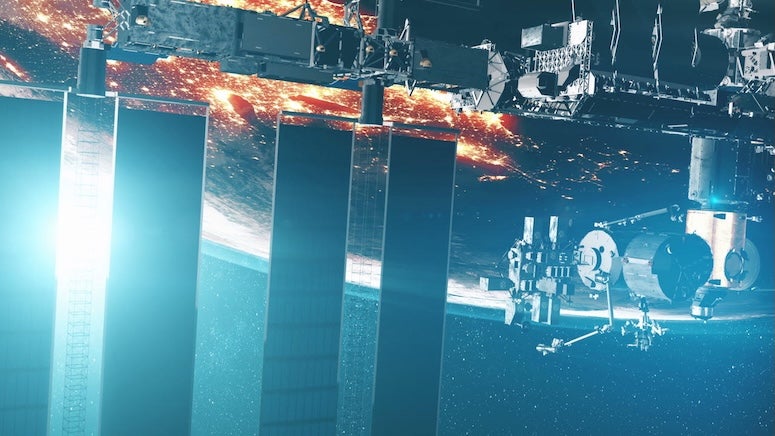
Rice University has signed an $8.1 million cooperative agreement to lead the United States Space Force University Consortium/Space Strategic Technology Institute 4 (SSTI), called the Center for Advanced Space Sensing Technologies (CASST) at Rice. Led by David Alexander, director of the Rice Space Institute, CASST will bring new technologies to advance remote sensing and sensemaking from space.
The research team includes Rice professors and staff Kevin Kelly, Tomasz Tkaczyk, Kenny Evans, Kaden Hazzard, Mark Jernigan and Vinod Veedu, as well as collaborators from University of California, Los Angeles; University of California, Santa Barbara; Georgia Institute of Technology; and Aegis Aerospace in Houston.
“This investment positions Rice at the forefront of the technologies that will define how we see, understand and operate in space,” said Amy Dittmar, the Howard R. Hughes Provost and executive vice president for academic affairs. “By bringing together advanced remote sensing, AI-driven analysis and cross-institutional expertise, CASST will help transform raw space data into real-time insight and expand the frontiers of scientific discovery.”
USSF, established in 2019, is the newest branch of the American armed services, formed in response to increased everyday reliance on space technologies. USSF uses space sensors to provide real-time information about space environments and potential threats in support of its mission to ensure security and superiority in the space domain. In support of that goal, USSF is partnering with research universities to support creation of Space Strategic Technology Institutes — CASST is the fourth such body established under this initiative. Funded by USSF and led by researchers, SSTIs facilitate collaborative applied research and drive transformative breakthroughs and technologies.
“Rice has helped shape the modern era of space research, and CASST marks a bold step into what comes next,” said David Sholl, executive vice president for research. “As space becomes more contested and more essential to daily life, the ability to rapidly sense, interpret and act on what’s happening beyond Earth is critical. This center brings together the materials, engineering and data science innovations needed to deliver that capability.”
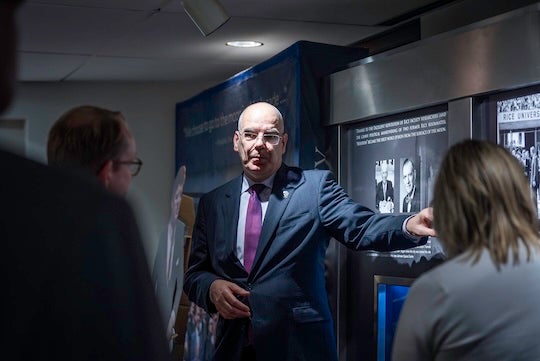
CASST will integrate existing leading-edge technologies into space sensors, expand their capabilities then optimize sensors to meet the specific challenges of use in space. The team will also work to miniaturize sensors while developing and implementing low-resource fabrication techniques. The researchers will use artificial intelligence and machine learning to analyze sensor data, allowing for real-time decision-making and decision support in response to sensor data.
“I’m excited to be leading this incredible collaborative effort,” said Alexander, professor of physics and astronomy and principal investigator on the project. “CASST will enable us to expand the range, ability and optimization of space remote sensing, reduce cost and resources required to build them and ensure the data they produce can be used in real-time to support USSF decision-making.”
Alexander is an inaugural member of the Texas Aerospace Research and Space Economy Consortium and serves on the boards of the Houston Spaceport Development Corporation, SpaceCom and the Sasakawa International Center for Space Architecture. He recently served on the board of the American Astronautical Society.
Such collaborations are emblematic of Rice’s rich history in space exploration. In 1959, Rice initiated research collaborations with a newly established NASA. Since then, the university has maintained a leadership role in advancing space science and technology with initiatives such as the Rice Space Institute and partnerships with other leading space organizations.
“CASST is a catalyst for Rice’s expanded role in national security. As a first step in a vital defense partnership, it fuses Rice’s research excellence with the USSF’s vision for a secure and superior space frontier,” said Veedu, assistant vice president for research and head of the university’s Defense Research Advancement initiative.