

Across Two Seas widens map of premodern Black history
Scholars, curators and filmmaker Daphne Di Cinto gather at Rice to explore Black histories from Renaissance Italy to medieval Africa and Islamic world.
Across Two Seas widens map of premodern Black history
Scholars, curators and filmmaker Daphne Di Cinto gather at Rice to explore Black histories from Renaissance Italy to medieval Africa and Islamic world.
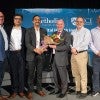
Rice, Houston Methodist and London School of Economics explore digital health collaboration
Rice and the Houston Methodist Research Institute have signed a memorandum of understanding with LSE Health at the London School of Economics and Political Science to explore collaboration on an interdisciplinary training program for future global health care leaders.

Rice’s Caroline Ajo-Franklin is part of an international research team funded by the United Kingdom’s Advanced Research and Invention Agency (ARIA), under its Universal Fabricator program.

Securing tomorrow: Rice hosts key leaders for inaugural summit on quantum and national security
Rice’s Defense Research Advancement initiative and the Smalley-Curl Institute recently hosted the inaugural Quantum Frontiers Summit, a first-of-its-kind gathering that brought together leaders from industry, academia and government to build a collaborative future vision for the rapid evolution of cutting-edge quantum technologies.

Rice to lead first national research security survey
Rice’s Tam Dao and Kenny Evans have received a federal grant to investigate the scope and frequency of foreign influence in U.S. institutions.

Rice MFA student reflects on Dolly Parton after years chronicling her life, legacy
Shima Oliaee created the podcast “Dolly Parton’s America,” which began as a four-hour interview with the superstar in her music recording studio in Nashville, Tennessee.
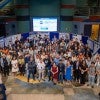
Smalley-Curl hosts 40th annual colloquium to ‘encapsulate Rice’s interdisciplinary drive’
Rice’s Smalley-Curl Institute recently hosted its 40th annual summer colloquium.

Who’s writing your medical record? AI in exam room more than notetaker
In a new article published in The Lancet, Rice’s Kirsten Ostherr and her co-authors argue that these tools known as ambient scribes do far more than take notes.

Rice professor advises computational chemistry researchers to prepare for new AI tools
David Sholl, Rice’s executive vice president for research and professor of chemical and biomolecular engineering, recently published an opinion piece in ACS Central Science, where he and co-author Andrew Medford, associate professor of chemical and biomolecular engineering at Georgia Institute of Technology, share their perspective on machine learning tools expected to bring radical changes to the field of computational chemistry.

Rice and TMC partners secure climate health consortium grant to face climate change and human health
A team of climate and environmental scientists, educators, epidemiologists and infectious disease researchers from Rice University, Baylor College of Medicine and the University of Texas School of Public Health has been awarded the inaugural Burroughs Wellcome Fund’s Climate + Health Excellence award, an initiative designed to strengthen research, education and public engagement related to climate change and human health.
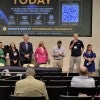
Humans to Mars and Moon Summit held at Rice
The 2026 Humans to Mars and the Moon Summit (H2M2), hosted by the nonprofit Explore Mars, was recently held at Rice’s BioScience Research Collaborative.

‘Experience like no other’: Rice professor serves as program chair for Lindau Nobel Laureate Meeting
Rice professor Pernilla Wittung Stafshede recently served as a co-organizer of the 75th Lindau Nobel Laureate Meeting, where she co-represented the field of chemistry.
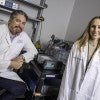
New mechanoresistant cancer cells show how they survive high stress environments
Rice bioengineer Michael King and his team recently published a paper demonstrating that this ability to survive high-stress environments, or mechanoresistance, can be induced in prostate cancer cells.

Rice and Max Planck advance global leadership in quantum materials and technology
Rice and the Max Planck Society officially launched the Quantum Materials - Rice and Max Planck Partnership (Q-RaMP) June 19, aimed at supporting the identification and development of quantum materials that will support breakthroughs in sustainability, energy efficiency and quantum and classical information processing.

Rice and Houston Methodist award seed grants for translational cancer research
Rice’s Synthesis X Center and Houston Methodist Neal Cancer Center have awarded $90,000 in seed grants as part of a new strategic collaboration.