
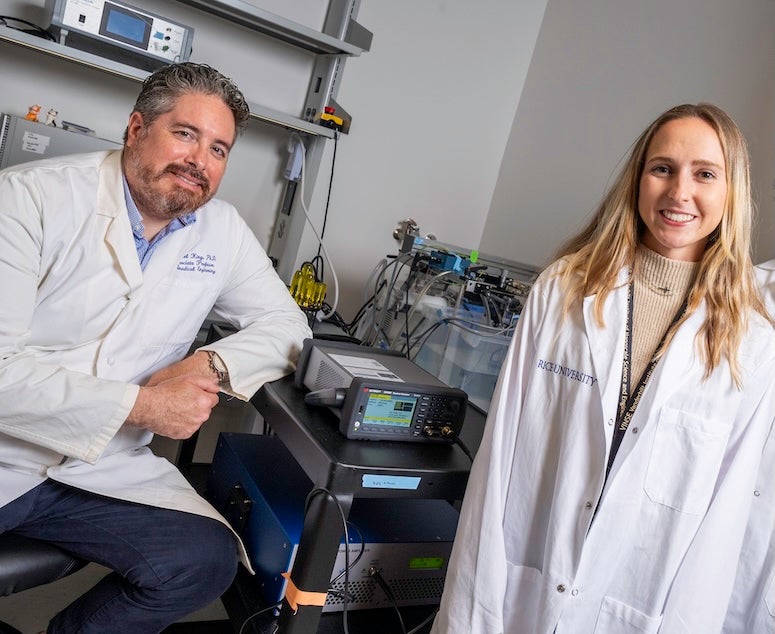
When a cancer cell leaves the original tumor to spread to a new, far away location, it first has to survive what most cells cannot: periodic high force moments in the vessels and heart of up to 5,000 dynes per centimeter squared as it circulates throughout the body. Rice University bioengineer Michael King and his team recently published a paper in Advanced Science demonstrating that this ability to survive high-stress environments, or mechanoresistance, can be induced in prostate cancer cells.
“By inducing mechanoresistance in the lab and then characterizing it,” said King, the E.D. Butcher Professor of Bioengineering and the corresponding author on the paper, “we are able to find entirely new predictors of metastasis and new drug targets. For instance, this study identified a gene called CALB2 that is strongly correlated with mechanoresistance.”
King’s team started with two different types of prostate cancer cells. One, LNCaP, was representative of early stage prostate cancer and was sensitive to androgen depravation, a common treatment. The other, PC3, was representative of advanced cancer and was resistant to androgen therapy.
“If you’re studying drug resistance, you give cells a drug, collect the survivors, grow them out and repeat until you have a population of cells that can survive even very high drug dosages,” said Abigail Fabiano, a recent doctoral graduate in King’s lab and the lead author on this paper. “To drive mechanoresistance, we put the cells under regular shear stress, collected the survivors, grew them out, added more stress and repeated until our cells could survive regular pulses of high shear stress, as if they were circulating in the body.”
Using a shear stress protocol developed in the King lab, Fabiano repeated this process over and over on the two cell types. After six months, the majority of the cells in both populations could survive regular pulses of shear force. Fabiano had created the first mechanoresistant cell cultures, showing that both early and late stage prostate cancers could develop the ability to easily survive circulation through the body.
The next step was to characterize these cells, so the team could start to understand why they had survived. While the mechanoresistant and mechanosensitive cells mostly looked the same, their genomes told different stories.
“We sequenced the entire genome of the mechanoresistant cell populations and found that they both had increased expression of a gene called CALB2,” Fabiano said. “CALB2 expression was also increased in cancer cells donated by metastatic prostate cancer patients. This indicates this genetic change, which could potentially be a driver of metastatic cancer, doesn’t just happen in the lab.”
To find out if CALB2 was driving the resistance to shear force, the team performed an elegant experiment. They took the mechanoresistant cells and with gene editing reduced CALB2 expression before subjecting the cells to the shear test. Cells with reduced CALB2 expression started dying in the shear test again; cells that kept their original high expression survived. CALB2 was clearly helping the cells survive high-pressure environments in a clear cause-and-effect manner.
“We may never have looked into CALB2 if we hadn’t developed this mechanoresistance model,” Fabiano said. “It isn’t a gene that’s been studied much in the context of cancer — prior to this, there’s been little indication it plays any role in cancer progression.”
While CALB2 doesn’t account for all of the mechanoresistance, it clearly played a key role in helping prostate cells survive their high-force trips throughout the body. But it wasn’t the only gene whose expression changed in the mechanoresistant cells; King’s lab is continuing to identify and study other potential drivers.
“This study opens an entirely new paradigm in the study of cancer,” King said. “Distant metastasis is incredibly difficult to treat in prostate and other cancers and is linked to poor patient prognosis. Our study shows that part of the metastatic ability can be characterized, with the potential of identifying risk factor mutations and new drug targets specific to a cell’s ability to spread throughout the body.”
This work was funded by the United States National Institutes of Health (R01CA256054), Cancer Prevention and Research Institute of Texas (RR230029, RP210116) and a National Science Foundation Graduate Research Fellowship (2021314768).