
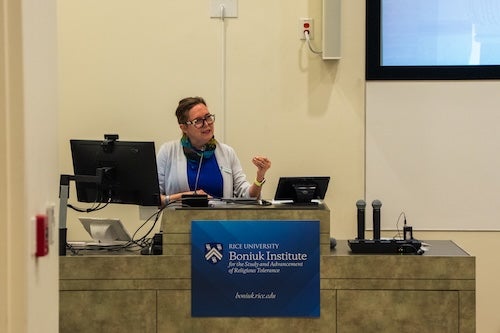
The Boniuk Institute for the Study and Advancement of Religious Tolerance at Rice University held the third annual Convening on Religious Violence and Religious Pluralism, a creative conference that brings together emerging and established academic experts from around the world to energize the intellectual climate around issues of religious pluralism and to spur interdisciplinary research on the conditions that foster and inhibit religious pluralism and religious conflict and violence.
The three-day conference kicked off with a welcome from David Sholl, executive vice president for research at Rice, whose office is tasked with elevating research from every corner of campus as well as finding opportunities for interdisciplinary work.
“One of the great things about my job is I get to celebrate research and scholarship across Rice University, and I was thinking recently about if you asked any researcher at Rice what’s the fundamental reason for their work? They would say that it’s to improve human life and to improve the planet around it,” Sholl said.
“In an ideal world, we, of course, would not need an institute at Rice that’s focused on religious tolerance, but we do not live in an ideal world. You’re all acutely aware of this, that in fact, perhaps these days more than any time in recent history we do need an institute focused on religious tolerance.”
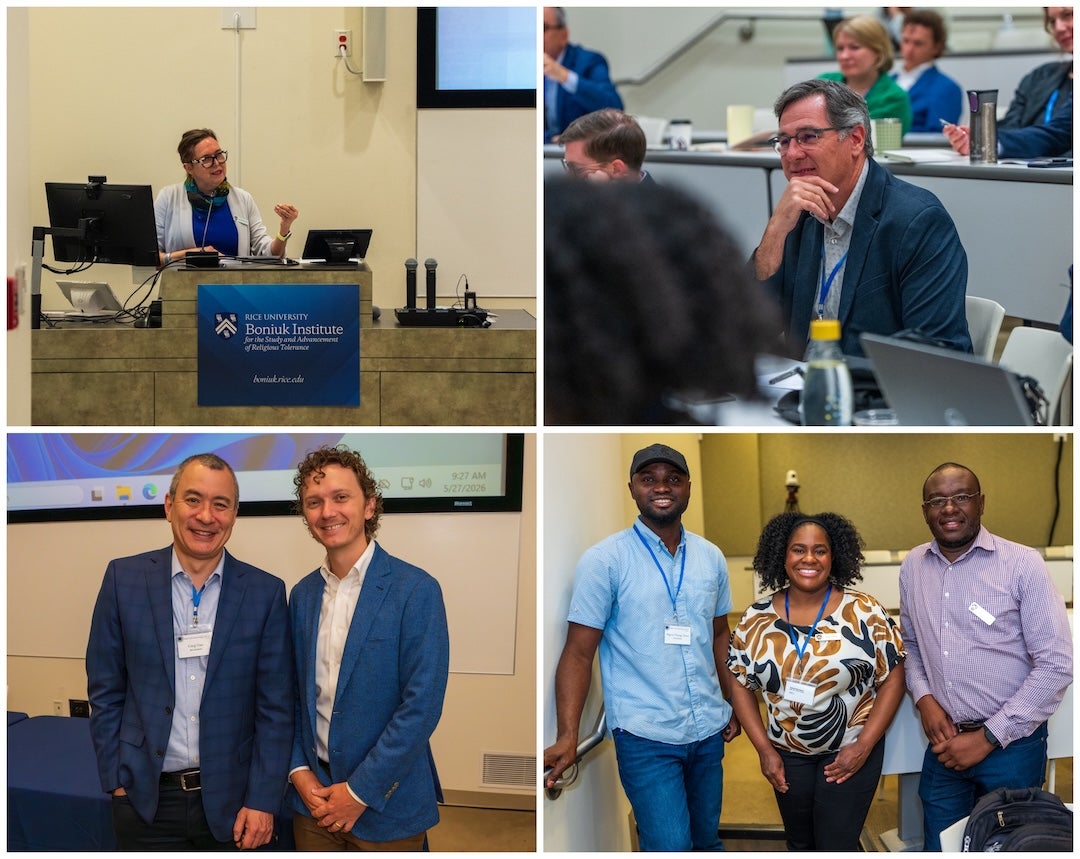
This year’s theme, Toward a New Agenda, is timely and urgent, said Elaine Howard Ecklund, director of the Boniuk Institute.
“When we look at the world around us, we see the dynamics of religion, conflict and pluralism are shaping modern society in real time,” Ecklund said. “We need you all at the table in this incredibly important time, and I want to say, too, we aren’t here just to do scholarship and leave it in the academy, just to observe these dynamics. We’re here to actively shape a new agenda, and in this particular convening, our goal is to dream of outputs that change the world.”
The Boniuk Institute is a premier interdisciplinary research and scholarly institute driven by a double mandate: to deeply understand the precise conditions that lead to religious pluralism and religious conflict in order to foster tolerance and pluralism, and to refuse to let research stay inside academia by bringing it to community leaders who can utilize the data and insights.
“We have gathered some of the best minds and the leading scholars in these areas in this room, and I want you to know that the consequences of what we’re doing over the next few days together, I think, are really great, that the world is waiting for some of the insights that we’re going to produce in this convening,” Ecklund said.
This year’s convening gathered experts from Princeton University, University of Oxford, American University of Beirut, National University of Singapore, Bar Ilan University and more, as well as community leaders from the Jung Center, the TMC’s Institute for Spirituality and Health, Bridges, Al Amana Center in Oman and other organizations. Presenters focused on topics such as Jewish-Muslim dialogues after the Gaza War, veiled religious violence imbedded in urban policies in largely pluralistic southeast Asia, the overlap of religion and mental health care and state-managed religious pluralism, and schools as a battleground for religious freedom.
The convening is an important part of the institute’s mission toward making meaningful change. By bringing together experts from around the globe to study different aspects and perspectives on religious violence and pluralism, conversations can move beyond theory and contribute to greater understanding, collaboration and practical solutions to complex social challenges and in turn extend beyond the conference, beyond the institute and into communities, other institutions and public life.
Learn more about the Boniuk Institute’s mission to discover new knowledge and promote meaningful change.
The convening was funded by the Boniuk Institute, Rice University’s Creative Ventures grant for “An Agenda for New Directions in Studying Religious Violence and Religious Pluralism,” and the Bryan J. and June B. Zwan Endowment.