

Rice researchers develop superstrong, eco-friendly materials from bacteria
Scientists at Rice and University of Houston have developed an innovative, scalable approach to engineer bacterial cellulose into high-strength, multifunctional materials.
Rice researchers develop superstrong, eco-friendly materials from bacteria
Scientists at Rice and University of Houston have developed an innovative, scalable approach to engineer bacterial cellulose into high-strength, multifunctional materials.

Near-perfect defects in 2D material could serve as quantum bits
Researchers at Rice and collaborators at Oak Ridge National Laboratory and the University of Technology, Sydney report the first demonstration of low noise, room-temperature quantum emitters in h-BN made through a scalable growth technique.

Rice scientists harness vacuum fluctuations to engineer quantum materials
Rice researchers and collaborators have developed a new cavity design that selectively enhances the quantum vacuum fluctuations of circularly polarized light in a single direction, achieving chirality — a feat that typically requires the use of a strong magnetic field.

Xie recognized for innovation in quantum phenomena
Rice's Yonglong Xie has been recognized for his innovation in quantum phenomena.

Rice researchers lay groundwork for designer hybrid 2D materials
An international team of researchers led by Rice materials scientists has succeeded in creating a genuine 2D hybrid material called glaphene.

Rice method refines ultrapure diamond film fabrication for quantum and electronic applications
Rice researchers have developed a simpler and more effective technique to make ultrapure diamond films for quantum and electronic applications.

Rice engineers tackle sunlight intermittency in solar desalination
A team of Rice engineers has developed a system that could transform desalination practices, making the process more adaptable, resilient and cheaper. The new system is powered by sunlight and uses a creative approach to heat recovery for extended water production ⎯ with and without sunshine.

Spotlight from The Franklin Institute Awards Ceremony: Celebrating Naomi Halas
Rice scientist and engineer Naomi Halas was awarded the 2025 Benjamin Franklin Medal in Chemistry May 1 at The Franklin Institute in Philadelphia.

Rice workshop unites global physicists to explore quantum frontiers
More than 80 scientists from around the globe gathered at Rice for the School on Electron Correlations and Topology.

Nobel laureate M. Stanley Whittingham shared insights from his pioneering work on lithium-ion batteries and addressed the future of energy storage during the Adams-Hauge Fund Smalley Lecture in Materials Science and Nanoengineering delivered at Rice.

Rice supporting World Engineering Day as official partner
Rice is an official partner for UNESCO World Engineering Day for Sustainable Development , which will be held at UNESCO’s Paris headquarters March 4.
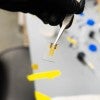
New method developed to dramatically enhance bioelectronic sensors
In a breakthrough that could transform bioelectronic sensing, an interdisciplinary team of researchers at Rice University has developed a new method to dramatically enhance the sensitivity of enzymatic and microbial fuel cells using organic electrochemical transistors (OECTs).

‘Smaller and better’: Rice research uncovers performance sweet spot for relaxor nanomaterial
A new study led by Rice materials scientist Lane Martin sheds light on how the extreme miniaturization of thin films affects the behavior of relaxor ferroelectrics — materials with noteworthy energy-conversion properties used in sensors, actuators and nanoelectronics.

Rice honors Nobel laureates Robert Curl and Richard Smalley at medal exhibit
Rice University celebrated a milestone in its scientific history Dec. 9 by displaying the Nobel Prize medals of late Rice chemistry professors Robert F. Curl ’54 and Richard Smalley at a daylong event held at the Welcome Center at Sewall Hall.

‘Pac-Man effect’ offers precise control for advanced materials design
Rice researchers show that exposing superparamagnetic colloids to a rotating magnetic field that reverses direction after each revolution generates a “Pac-Man effect” due to magnetic relaxation.