
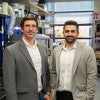
A new study from mechanical engineers at Rice describes a surprisingly straightforward fix for superhydrophobic surfaces: Instead of just engineering the surface’s chemistry and texture, they focused on engineering its heat flow.
A new study from mechanical engineers at Rice describes a surprisingly straightforward fix for superhydrophobic surfaces: Instead of just engineering the surface’s chemistry and texture, they focused on engineering its heat flow.
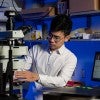
Metabolic clues emerge from new molecular map of Alzheimer’s
Rice scientists have developed the first complete, label-free molecular atlas of the Alzheimer’s brain in an animal model.
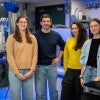
Smart clothing coming sooner than you think and Rice engineers are helping build it
Rice professors of mechanical engineering Daniel J. Preston and Vanessa Sanchez are core partners in the New Frontiers in Research Fund project led by the University of Alberta, bringing breakthrough materials, soft-robotic actuation and human-centered design to the team.
Researchers led by Guido Pagano used a specialized quantum device to simulate a vibrating molecule and track how energy moves within it.

A Rice-led team has unveiled how tiny molecular structures on industrial catalysts behave during the manufacture of vinyl acetate monomer, a core ingredient in adhesives, paints, coatings, packaging, textiles and many other products people use every day.

Rice and MD Anderson build patient-specific models to guide complex pelvic cancer surgeries
A new collaboration between Rice engineers and physicians at the University of Texas MD Anderson Cancer Center is giving surgeons a powerful new way to plan pelvic reconstructions before they ever step into the operating room.

Rice researchers uncover the hidden physics of knot formation in fluids
A team of researchers at Rice, Georgetown University and the University of Trento in Italy has uncovered a surprising physical mechanism that explains how a single filament can form a knot while sinking through a fluid under strong gravitational forces.
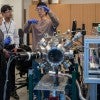
Rice convenes global researchers to advance understanding of quantum geometry in materials
The Rice Center for Quantum Materials hosted a Workshop on Quantum Geometry and Winter School on Quantum Materials Synthesis, bringing together more than 100 researchers, students and scientific leaders from around the world.

Rice engineers show lab-grown diamond films can stop costly mineral buildup in pipes
A new study by Rice engineers shows that lab-grown diamond coatings could help diminish mineral scaling in industrial piping, providing an alternative to chemical additives and mechanical cleaning, both of which offer only temporary relief and carry environmental or operational downsides.

New recharge-to-recycle reactor turns battery waste into new lithium feedstock
A team of engineers at Rice has developed a cleaner approach to lithium recycling by recharging the waste cathode materials to coax out lithium ions into water.
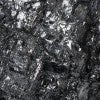
Rice researchers weigh in on graphite’s rise to critical mineral status, mapping out trajectories toward more resilient, clean and efficient supply practices and systems.

Rice brings together leading researchers to accelerate next-generation microelectronics
The Rice Advanced Materials Institute (RAMI) hosted a signature workshop centered on advanced microelectronics and photonics materials Nov. 3-4.

Kono awarded American Physical Society’s Isakson Prize
Rice applied physicist Junichiro Kono has been awarded the American Physical Society’s 2026 Frank Isakson Prize for Optical Effects in Solids.

Study shows light can reshape atom-thin semiconductors for next-generation optical devices
Rice researchers studying a class of atom-thin semiconductors known as transition metal dichalcogenides have discovered that light can trigger a physical shift in their atomic lattice, creating a tunable way to adjust the materials’ behavior and properties.

Rice mechanical engineers turning everyday fabrics into new channel of communication
When Rice doctoral candidate Barclay Jumet first launched a high school business designing, making and selling bow ties — learning to sew on his mother’s college sewing machine — he never imagined that same skill set would one day help him reinvent how people communicate.