Rice sociologist Elaine Howard Ecklund joined Nature’s career podcast “Working Scientist” to share her research on religion among scientists and discuss her book “Secularity and Science: What Scientists Around the World Really Think About Religion.”
The conflict between Israel and Palestine has had a big effect on relationships toward religious people in the U.S., and the recent war in Gaza has made these tensions even stronger. It has also led to more discrimination and harm toward both Jewish and Muslim Americans, yet there have been important changes in bias and fear, according to a new Rice University study sponsored by Rice’s Boniuk Institute for the Study and Advancement of Religious Tolerance.
“Religious studies lets you inhabit another person’s worldview,” said Judith Ellen Brunton, assistant professor of religion and a Boniuk Institute Faculty Fellow.
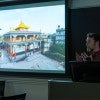
An exploration of how Tibetan Buddhist and scientific traditions each understand and attempt to study the tukdam state has taken filmmaker and scholar Donagh Coleman from Himalayan monasteries to neuroscience labs around the world.
Whether it’s a journalist unpacking democracy, a historian reframing medicine or an artist probing the legacies of empire, these lectures invite the community to listen, learn and question.
As workplaces continue to grow more diverse and dynamic, many workers are thinking more deeply about how to stay true to their spiritual values while actively contributing to their organizations. A new book by a Rice University expert explores this growing need and offers a thoughtful framework for navigating faith at work.
A powerful work of public art that captured global attention when it first appeared on the facade of the Jerusalem Tolerance Museum is now making history on American soil. The “Woman Life Freedom” mural, created by Iranian-American filmmaker and activist Hooman Khalili, was recently unveiled at Rice, becoming the first temporary installation of its kind on a U.S. college campus.
Housed within the Woodson Research Center at Fondren Library, the archives have amassed more than a million documents, recordings and files related to unexplained phenomena.
The Boniuk Institute for the Study and Advancement of Religious Tolerance recently gathered scholars representing nearly a dozen different nations at the Rice University Global Paris Center to discuss new directions for global research on religious violence and pluralism.
Hosted by the School of Humanities, the annual Kazimi Lecture honors the memory of Syed Safdar and Samina Kazimi by inviting artists and scholars whose work deepens understanding of Shi’i Islam.
Rice Reflects, an initiative from the Office of the Provost, brought bestselling author Sandy Tolan to McMurtry Auditorium March 10 to discuss free speech and the historical context of the Israel-Palestine conflict.
The website functions like a digital museum exhibit, offering story maps, GIS map visualizations and advocacy tools to help communities understand and respond to potential environmental risks.
A distinguished scholar of German Protestantism and intellectual history, John Stroup will be remembered for his wit and passion as well as his impact on academia, his colleagues and his students over a career that spanned more than four decades.
Including religious identities in diversity, equity and inclusion efforts could positively impact workplace culture and communities as a whole, according to newly published research from Rice University’s Boniuk Institute for the Study and Advancement of Religious Tolerance.
Rice’s Boniuk Institute for the Study and Advancement of Religious Tolerance hosted a celebration at Cohen House Aug. 28 to launch the new Religion and Public Life Center (RPLC). The center’s goal is to use research on religion to build common ground for the common good.