
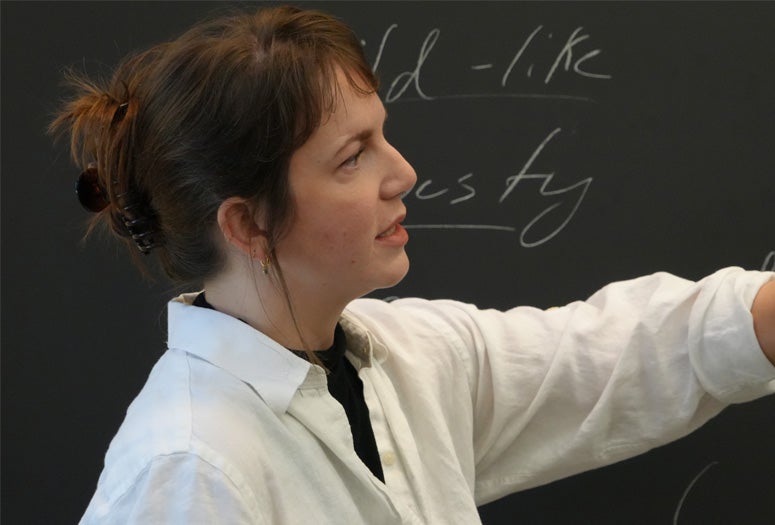
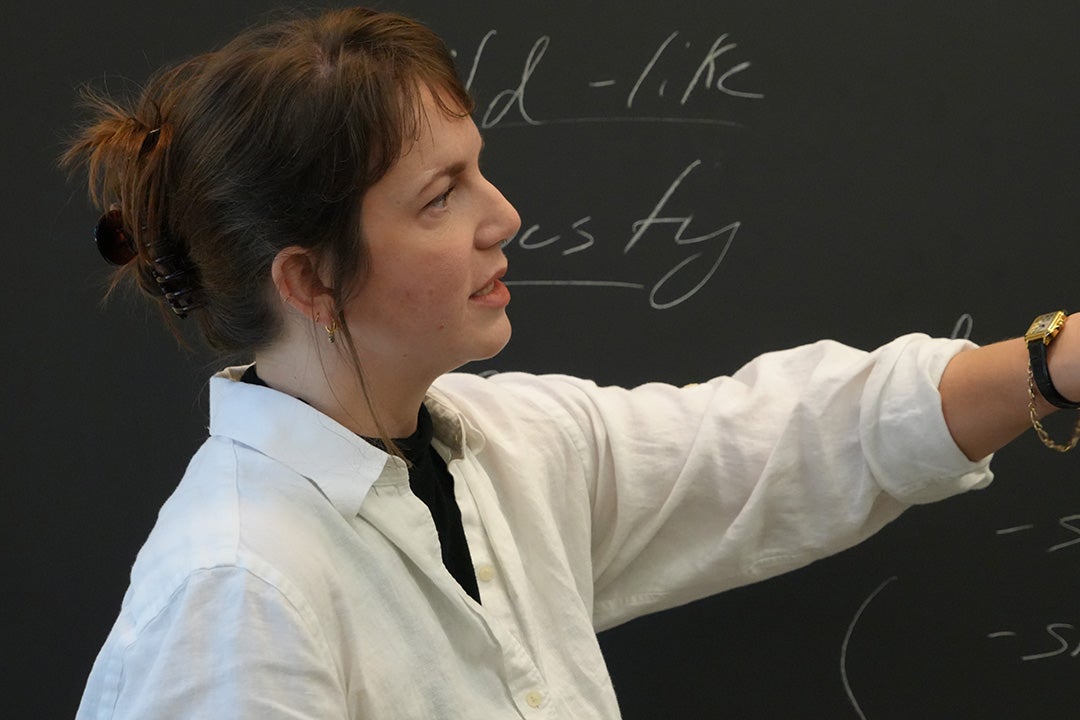
For Judith Ellen Brunton, studying religion isn’t about what happens in churches, temples or synagogues. It’s about the moral frameworks that guide how people live, work and imagine the world around them.
“Religious studies lets you inhabit another person’s worldview,” said Brunton, assistant professor of religion and a Boniuk Institute Faculty Fellow at Rice University. “When you ask questions about how people see the world and what they value, you start to see that religion happens everywhere.”
That wide-angled way of seeing the world has shaped Brunton’s research across borders, industries and disciplines. A scholar of religion, the environment and the cultural study of science, she looks at how people’s worldviews — religious or otherwise — influence what they believe the natural world is for and how they think it should be used. Her current book project, which is based on years of ethnographic research in her native Alberta, Canada, investigates how oil extraction shapes cultural imaginaries of the “good life.”
“I grew up in Calgary, where oil is everywhere — in the economy, the skyline and even the stories people tell about themselves,” Brunton said. “What fascinated me was how oil wasn’t just a resource. It was a moral landscape, a way people tested themselves and their communities against an idea of what a good life should be.”
Brunton’s book traces how corporations, government agencies and community organizations use oil to express ethical and cultural values. She has studied corporate boosterism campaigns, energy heritage sites and even the Calgary Stampede, identifying how these public narratives blend faith in human ingenuity with reverence for the land’s power. What emerges, she argues, is a kind of energy cosmology — a spiritual framework for living that treats extraction as a moral act.
“Even in systems we think of as secular — economics, technology, industry — there are values at work,” Brunton said. “Efficiency, productivity, control over nature. Those are moral ideas too. My job is to uncover them and ask what stories they’re telling about who we are.”
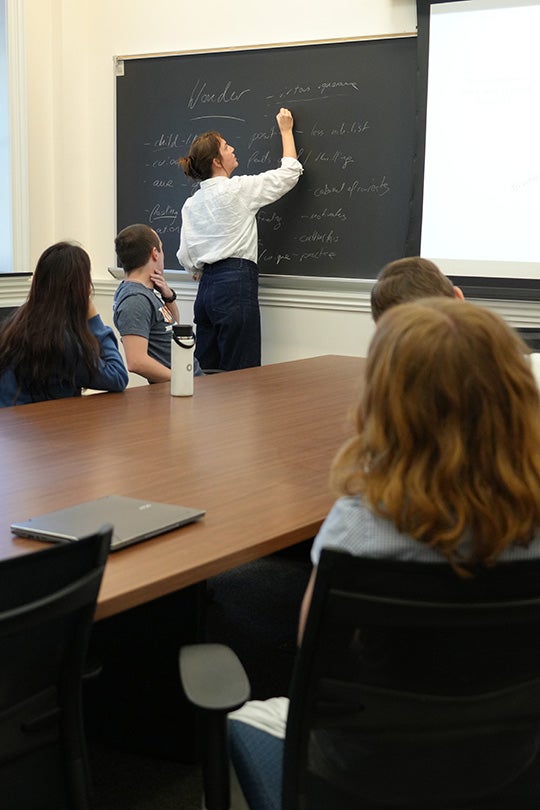
A new addition to Rice’s faculty last academic year, Brunton continues to expand her exploration of religion and environment through her teaching. This fall, she’s teaching Religion and Science as well as Sacred Birth, a course inspired by Brunton’s co-authored chapter “Birthing” in “The Routledge Handbook of Religion and American Culture.” The course looks at how birth practices reflect cultural, moral and religious ideas about bodies, creation and care. It asks students to think about where spiritual and medical worldviews meet in the most intimate moments of human life. Her class Religious World Views and the Environment, which she’ll teach again in spring 2026, challenges students to see environmental crises not just as scientific problems but as moral and cultural ones too.
“The class isn’t about giving students a single answer,” Brunton said. “It’s about giving them language to recognize that scientific, economic and spiritual worldviews are all ways of knowing and they all shape how we respond to the planet’s challenges.”
Brunton’s teaching fits naturally with Rice’s growing focus on collaboration across disciplines, especially where the sciences and humanities meet. In her classroom, climate change and environmental ethics become openings for deeper conversations about what people believe is worth protecting — and why.

“It’s exciting to teach at a place like Rice where students come in with such strong backgrounds in science and engineering,” Brunton said. “They bring this incredible analytical energy. What I get to do is help them see how moral imagination and storytelling are also analytical tools. They shape how we use energy, how we think about technology and how we define progress.”
That curiosity also drives Brunton’s next wave of research. Beyond Alberta, she’s turning her attention to resource extraction ghost towns and dowsing traditions — historical and cultural practices that reveal how humans have long sought meaning and direction in the land beneath them. She’s particularly interested in the ways communities inherit “spiritual infrastructures” from previous generations of industry, faith and labor.
Brunton’s work dovetails naturally with the Boniuk Institute’s mission to study pluralism and moral life and with Rice’s growing investment in the environmental humanities.
“It’s a place that values curiosity and collaboration,” she said. “I get to think about big questions alongside people who study energy, ethics, ecology and everything in between.”
Brunton often returns to a favorite idea from Indigenous scholar Thomas King, who wrote, “The truth about stories is that that’s all we are.” For her, that idea isn’t just literary; it’s ethical.
“The stories we tell about energy, about birth, about work — they aren’t just reflections of the world. They make the world,” Brunton said. “So we have to be careful which stories we keep telling and brave enough to imagine new ones.”