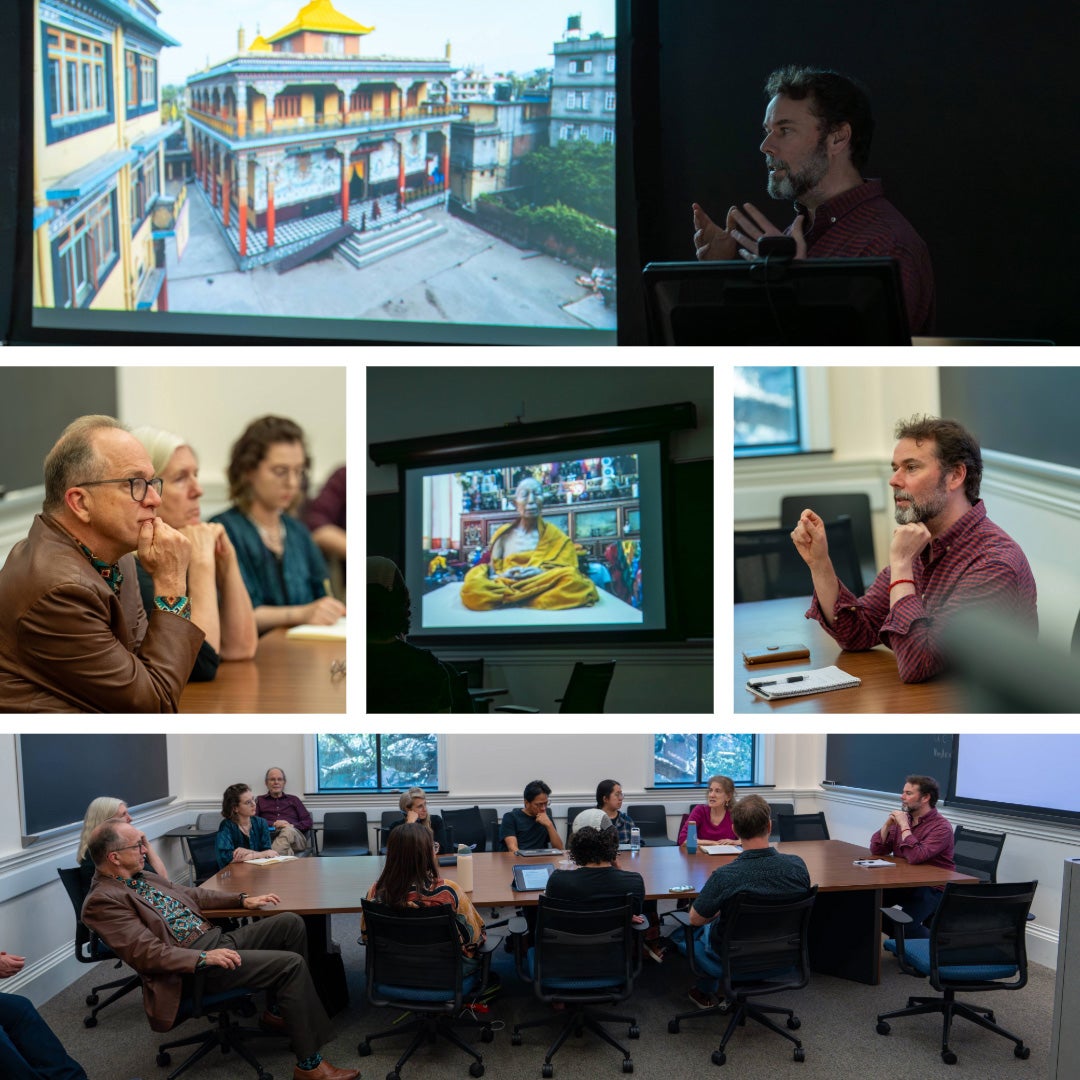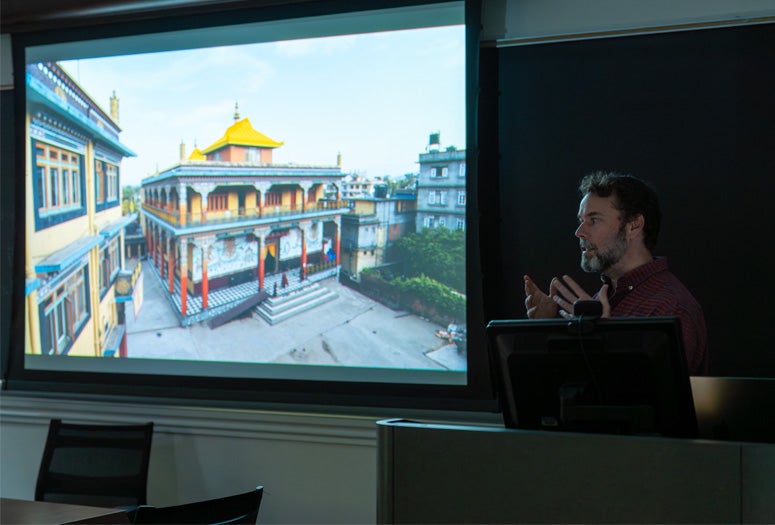
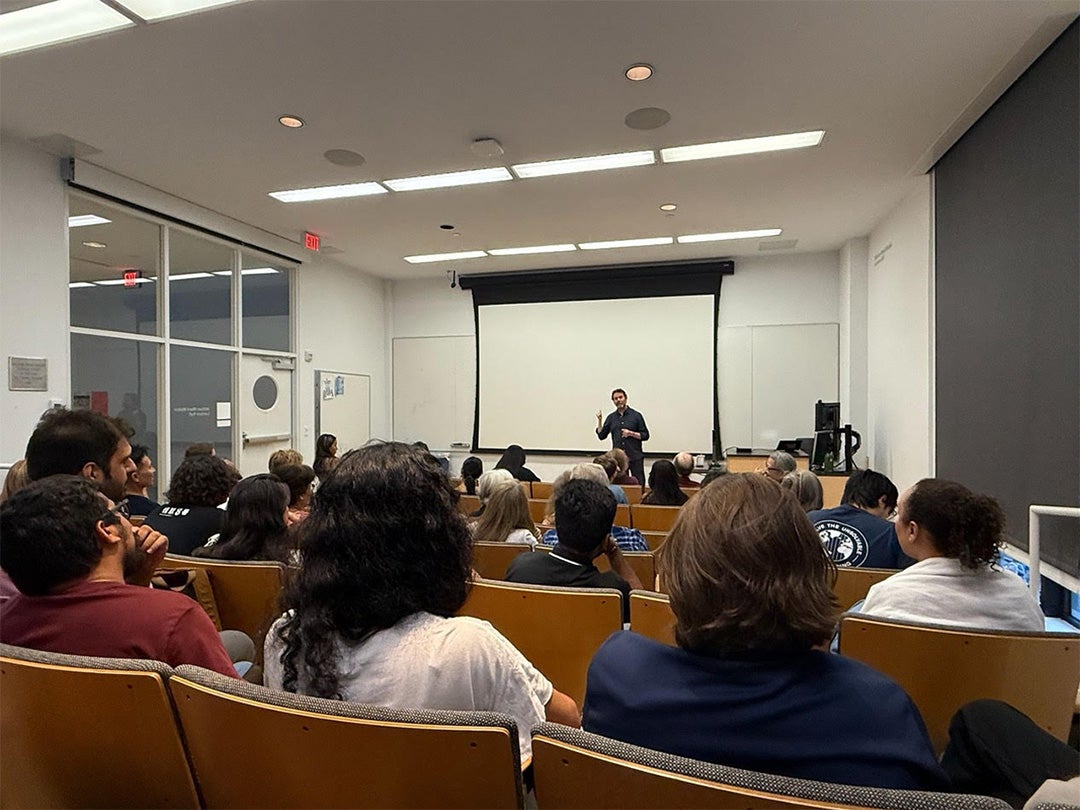
When Finnish-Irish-American filmmaker and scholar Donagh Coleman brought his award-winning documentary “Tukdam: Between Worlds” to Rice University Oct. 8, the screening became more than a film event. It was an invitation to reexamine how we understand life, death and the nature of consciousness itself.
The film, which explores the Tibetan Buddhist phenomenon of tukdam — when advanced meditators remain lifelike for days or even weeks after clinical death — was screened for students and faculty in Anderson Hall. The screening was followed by a Q&A session with Coleman, who also spent the week visiting classes and meeting with faculty across religious studies and anthropology.
“As a filmmaker and as a scholar, it was very heartening to encounter such enthusiasm, interest and fascination in this area that I’m working in,” said Coleman, who is pursuing a doctorate in medical anthropology at the University of California, Berkeley. “This reignited my excitement about the work that I’m doing.”
That work — an exploration of how Tibetan Buddhist and scientific traditions each understand and attempt to study the tukdam state — has taken Coleman from Himalayan monasteries to neuroscience labs around the world. His film juxtaposes Tibetan and Western perspectives, revealing how tukdam challenges long-held medical and philosophical ideas about where life ends and what consciousness may be.
“The way it kind of blurs the lines between life and death and mind and body, it just upends the modern Western categories that we have for these things in really exciting ways,” Coleman said.
During his visit, Coleman joined discussions in classes taught by professors Anne C. Klein and Jeffrey Kripal, whose research explores questions of consciousness, spirituality and extraordinary human experience. Klein said Coleman’s visit underscored how the humanities can shed light on questions that science alone cannot answer.
“The phenomenon of tukdam speaks directly to what makes us human — the mystery of death, the relationship between body and mind and the search for meaning that unites all fields of study,” Klein said. “What Donagh’s film does so beautifully is bring those questions into shared space, where scientific and contemplative traditions can meet as equals.”
Klein, who studies Tibetan Buddhism and Dzogchen traditions, noted that Coleman’s visit was supported by the Department of Religion, the Chao Center for Asian Studies with publicity also aided by the Medical Humanities program. She also noted that his documentary’s impact reached beyond religious studies.
“It’s relevant to philosophy, literature and even the biological sciences, because it challenges us to think differently about consciousness and what it means to be alive,” Klein said.
For Coleman, that was precisely the point of his visit to Rice.
“I hope this work can loosen some of our rigid preconceptions about reality — about life and death and about what consciousness is,” Coleman said. “If it opens new questions and fresh ways of thinking, that’s enough for me.”
“Tukdam: Between Worlds” is available to rent on Amazon Prime.