

From field to lab: Rice study reveals how people with vision loss judge approaching vehicles
A new study uses a virtual reality system to examine how adults with and without AMD estimate when an approaching vehicle would reach them.
From field to lab: Rice study reveals how people with vision loss judge approaching vehicles
A new study uses a virtual reality system to examine how adults with and without AMD estimate when an approaching vehicle would reach them.
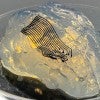
Materials that match the brain: Rice engineer earns Sontag Foundation distinction
Rice materials scientist and neuroengineer Christina Tringides has been named a Distinguished Scientist by the Sontag Foundation, a national recognition for early career researchers advancing transformative projects in brain cancer research.
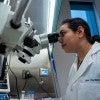
A molecular ‘reset button’ for reading the brain through a blood test
Rice bioengineers have designed an erasable serum marker that could enable clinicians to detect problems or measure any changes in how a patient responds to treatment with greater precision, using simple, minimally-invasive testing.

How AI can help detect disease and accelerate medical breakthroughs
As artificial intelligence plays an increasingly prominent role in decoding DNA, tracking pathogens and accelerating drug discovery, the line between real capability and hype can be unclear. Rice experts can provide clear, technically grounded perspectives on how these tools are meaningfully advancing disease detection, public health preparedness and treatment design.

Losing sleep over money: Rice study reveals how financial stress follows workers to bed
New research from Rice shows “stress-before-bed behaviors” as a key mechanism linking financial worry and job insecurity to declining sleep quality.

Rice’s Baker Institute for Public Policy has received a landmark $7.5 million gift from entrepreneur Claudio X. González, the largest individual contribution in the institute’s 32-year history. The gift endows and renames the institute’s leading research hub on U.S. and Mexico relations as the Claudio X. González Center for the United States and Mexico. The naming honors González’s long-standing leadership and generosity in promoting collaboration, understanding and shared prosperity across North America.

New research from Rice show major storms are spreading industrial contaminants across entire neighborhoods, raising concerns about future well-being.
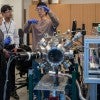
Rice convenes global researchers to advance understanding of quantum geometry in materials
The Rice Center for Quantum Materials hosted a Workshop on Quantum Geometry and Winter School on Quantum Materials Synthesis, bringing together more than 100 researchers, students and scientific leaders from around the world.
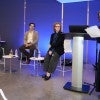
The event was organized in conjunction with “Bio Morphe,” the Moody’s current exhibition exploring how select contemporary artists evoke biomorphism — the aesthetics of organic material and forms — in their work.

Rice engineers show lab-grown diamond films can stop costly mineral buildup in pipes
A new study by Rice engineers shows that lab-grown diamond coatings could help diminish mineral scaling in industrial piping, providing an alternative to chemical additives and mechanical cleaning, both of which offer only temporary relief and carry environmental or operational downsides.

Rice’s Paris partnerships signal new phase in university’s global ascent
Together, they represent more than two signatures in Paris; they signal Rice’s movement from participating in global academia to shaping it.
Rice establishes Amyloid Research Center to tackle neurodegenerative diseases
Rice has launched the Amyloid Mechanism and Disease Center, a new campus hub dedicated to uncovering the molecular origins of Alzheimer’s, Parkinson’s and other amyloid-related diseases.

Rice engineers reveal molecular dynamics that underpin concrete’s durability
A new molecular dynamics study from Rice sheds light on what's happening inside the hidden channels inside concrete.
Sharper MRI scans may be on horizon thanks to new physics-based model
Researchers at Rice and Oak Ridge National Laboratory have unveiled a physics-based model of magnetic resonance relaxation that bridges molecular-scale dynamics with macroscopic magnetic resonance imaging (MRI) signals, promising new insight into how contrast agents interact with water molecules.
Two-step flash Joule heating method recovers lithium‑ion battery materials quickly and cleanly
A Rice research team has developed a process that rapidly separates lithium and transition metals from spent lithium-ion batteries. The method provides an acid-free, energy-saving alternative to conventional recycling techniques,