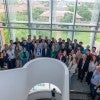
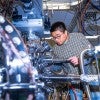
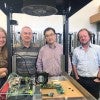
The Rice Center for Quantum Materials recently hosted the second edition of the Workshop on Quantum Materials Synthesis, an event dedicated to communicating recent developments in the field, identifying new research areas and providing a platform for theorists and experimentalists to come together for discussion and knowledge exchange.
Megan Reiter, an assistant professor of physics and astronomy at Rice University, has won a National Science Foundation (NSF) CAREER Award to investigate the influence of neighboring stars on the formation of planets.
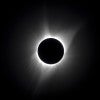
As the moon completely eclipsed the sun April 8, more than 300 Rice University alumni, faculty and staff gathered on the lawn of the Flying L Ranch Resort in Bandera, Texas, to view the last total solar eclipse in the contiguous United States for the next two decades.
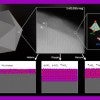
Rice physicists have discovered a phase-changing quantum material — and a method for finding more like it — that could potentially be used to create flashlike memory capable of storing quantum bits of information, or qubits, even when a quantum computer is powered down.
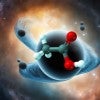
A team of researchers from Rice University and the University of Illinois Urbana-Champaign has shown that molecules can be as formidable at scrambling quantum information as black holes by combining mathematical tools from black hole physics and chemical physics and testing their theory in chemical reactions.
Rice University’s Junichiro Kono has assumed leadership of the Smalley-Curl Institute, named for Nobel Laureates Richard Smalley and Robert Curl ’54 and home to some of the world’s most accomplished researchers in nanoscience, quantum science and materials science.
Nationally recognized solar eclipse and solar power experts from Rice University are available to discuss the April 8 eclipse, which will be the last total solar eclipse in the U.S. for 20 years.
A team of physicists at Rice University led by Wei Li has been awarded a five-year, $15.5 million grant from the U.S. Department of Energy (DOE) Office of Nuclear Physics, marking a significant leap forward in the realm of high-energy nuclear physics.
Rice University’s Naomi Halas has been selected as the 2024 recipient of the C.E.K. Mees Medal by Optica for her “original use of optics across multiple fields.”
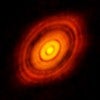
Rice University astronomer Andrea Isella and colleagues have reported the first observations of gaseous water in the portion of a protoplanetary disk where a rocky, Earth-like planet might be forming around a distant star.
The Rice lab of nanotechnology pioneer Naomi Halas has uncovered a transformative approach to harnessing the catalytic power of aluminum nanoparticles by annealing them in various gas atmospheres at high temperatures.
NASA has released the first stunning images of the Orion Nebula from the James Webb Space Telescope in a study in the journal Science that shows with unprecedented precision how massive stars impact the formation of planetary systems.
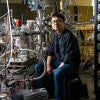
Yonglong Xie, assistant professor of physics at Rice University, has been awarded a Faculty Early Career Development (CAREER) Award from the National Science Foundation (NSF). The $888,555 grant over five years will support Xie’s research into harnessing magnons, quantum mechanical wavelike objects in magnetic materials, to create synthetic matter and develop next-generation quantum devices and sensors.
Rice scientists have discovered a first-of-its-kind material, a 3D crystalline metal in which quantum correlations and the geometry of the crystal structure combine to frustrate the movement of electrons and lock them in place.