
Rice graduate students awarded NSF INTERN grants for real-world research opportunities
Rice graduate students Eric Wuesthoff and Esther Jimenez are the recipients of the National Science Foundation’s INTERN awards.
Rice graduate students awarded NSF INTERN grants for real-world research opportunities
Rice graduate students Eric Wuesthoff and Esther Jimenez are the recipients of the National Science Foundation’s INTERN awards.
Researchers teaching artificial intelligence about frustration in protein folding
Peter Wolynes and his colleagues have found a new way to predict how proteins change their shape when they function.
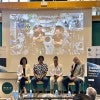
‘Nothing is going to come easy’: A conversation between Olympians and astronauts
Rice helped bring together Olympic and Paralympic athletes with astronauts on board the International Space Station for a talk on the similarities between space exploration and elite sports.

‘Out of all the unknowns in science, we have so much to discover’
Rice’s Smalley-Curl Institute held its 38th annual Summer Research Colloquium Aug. 2 at Rice’s Duncan Hall, where undergraduate and graduate students and postdoctoral researchers gave presentations covering topics in nanoscience, quantum materials and quantum information science and technology to a multidisciplinary audience.
Researchers make breakthrough in fight against COVID-19
Jose Onuchic is part of a research team that has made a discovery in the fight against SARS-CoV-2, the virus responsible for COVID-19.

New twist on synthesis technique developed at Rice promises sustainable manufacturing
James Tour’s lab at Rice has developed a new method known as flash-within-flash Joule heating.
Researchers unveil mysteries of ancient Earth
A research team led by Rice’s Duncan Keller and Cin-Ty Lee studied massif-type anorthosites to test ideas about the magmas that formed them.
Angel Martí elected fellow of the American Chemical Society
Rice’s Angel Martí has been elected a fellow of the American Chemical Society, one of his discipline’s highest honors.

Rice’s Sylvia Dee working to improve projections of extreme droughts, floods
Rice climate scientist Sylvia Dee has won a National Science Foundation CAREER Award, the agency’s most prestigious early career honor.

New $12M research project aims to provide ‘practical solutions to critical environmental challenges’
Scientists at Rice, in collaboration with the U.S. Army Engineer Research and Development Center, are making headway in addressing per- and polyfluoroalkyl substances (PFAS) contamination.

Rice researchers develop innovative battery recycling method
A research team at Rice led by James Tour is tackling the environmental issue of efficiently recycling lithium ion batteries amid their increasing use.
Rice chemist James Tour has led a research team to develop a rapid electrothermal mineralization process, which in seconds can remediate the accumulation of synthetic chemicals that can contaminate soil and the environment.

Rice researchers explore the effects of stellar magnetism on potential habitability of exoplanets
A new study by Rice’s David Alexander and Anthony Atkinson extends the definition of a habitable zone for planets to include their star’s magnetic field.

RSI awards seed funding grants to propel ‘pioneering’ space exploration research at Rice
The Rice Space Institute has awarded $150,000 in seed funding to Rice researchers to further our understanding of the universe and humanity’s place in it.

Rice’s Emilia Morosan awarded prestigious Vannevar Bush Faculty Fellowship
Physicist wins Department of Defense’s most prestigious single-investigator award