

In a significant step toward creating a sustainable and circular economy, Rice researchers have published a landmark study demonstrating that carbon nanotube fibers can be fully recycled without any loss in their structure or properties.
In a significant step toward creating a sustainable and circular economy, Rice researchers have published a landmark study demonstrating that carbon nanotube fibers can be fully recycled without any loss in their structure or properties.

Rice experts available to discuss potential U.S. TikTok ban
Rice University experts are available to provide insights into the ethical, economic and social implications of a potential TikTok ban.

Rice experts available to address Southern California’s life-threatening wildfires
Rice University experts are available to provide insights into the environmental, infrastructural and societal impacts of the windstorms and wildfires threatening Southern California.

Rice and Houston Methodist award seed grants for digital health research
The grants aim to accelerate the translation of technologies into clinical applications.

Rice and Houston Methodist have joined forces to establish the Digital Health Institute aimed at transforming health care for millions through advanced technology and collaborative expertise.

Rice experts featured in Emmy Award-winning documentary on AI impact, promise and risks
Rice researchers are featured in a Telemundo documentary on artificial intelligence that won a Lone Star Emmy Award.

Richard Baraniuk honored with 2025 IEEE Signal Processing Medal
Richard G. Baraniuk, the C. Sidney Burrus Professor of Electrical and Computer Engineering at Rice University, has been awarded the 2025 IEEE Jack S. Kilby Signal Processing Medal.

Workshop highlights ‘pivotal moment’ for future of AI in space exploration
The In-Space Physical AI Workshop convened top scientists, engineers, entrepreneurs and government leaders to explore the role of AI in space exploration.
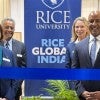
Rice University announces strategic expansion into India with Rice Global India
Rice is expanding its international presence with the launch of Rice Global India. This strategic initiative underscores the university’s commitment to fostering global collaboration and advancing its contributions to India’s rapidly growing education and technology sectors.

Rice’s Ken Kennedy Institute names David Pynadath new executive director for research initiatives
The Ken Kennedy Institute at Rice University has named David Pynadath as its new executive director for research initiatives.

Rice-led research will leverage responsible AI to enhance coastal communities’ severe storm response
A team of Rice engineers and partners won a $1.5 million NSF award for a project that leverages responsible AI to enhance emergency response to coastal compound hazard events.

Research institute representative highlights Texas’ collaborative efforts with Rice in cancer battle
Abria Magee, senior program manager for the Cancer Prevention and Research Institute of Texas, gave an overview of the agency’s efforts to fuel innovation in cancer research and drive advancements in prevention and cures at the recent AI in Health Conference hosted by Rice’s Ken Kennedy Institute.

Rice partners with BeOne Sports to transform athlete performance with AI technology
Rice’s Athletics Department and Office of Innovation have formed a strategic partnership with BeOne Sports, an innovative startup founded by Rice alumni that is pioneering advanced sports performance technology.

Momentous: Personalized Scale for Global Impact: Rice unveils new strategic plan
Under the leadership of President Reginald DesRoches, Rice has unveiled a new strategic plan to become the world’s premier teaching and research university by delivering unparalleled personalized education and propelling breakthrough discoveries to transform lives and better humanity. Momentous: Personalized Scale for Global Impact serves as a road map for the next decade and reflects the collective contributions of the entire Rice community, capitalizing on the university’s size as a competitive advantage.

Rice’s school of engineering changes its name to reflect excellence in computing
Rice’s school of engineering has officially changed its name to the George R. Brown School of Engineering and Computing.