

Rice joins federal consortium on AI safety
Rice has joined the nation’s leading artificial intelligence stakeholders to participate in a Department of Commerce initiative to support the development and deployment of trustworthy and safe AI.
Rice joins federal consortium on AI safety
Rice has joined the nation’s leading artificial intelligence stakeholders to participate in a Department of Commerce initiative to support the development and deployment of trustworthy and safe AI.

Rice University’s 2024 biennial De Lange Conference featured an array of distinguished speakers, artists and researchers who engaged in thought-provoking discussions regarding timely technological and environmental topics Feb. 9-10 at the Baker Institute for Public Policy.

Rice to host International Workshop on AI-Powered Space
Rice’s AI Houston Institute, in collaboration with NASA, will host the two-day International Workshop on AI-Powered Space, covering the latest advances in artificial intelligence (AI) theory and practice in core space and extended space at the university’s tech hub, the Ion.

Rice U.’s Kaiyu Hang wins NSF CAREER Award
Kaiyu Hang, an assistant professor of computer science at Rice University, has won a National Science Foundation CAREER Award to develop robots that can manipulate unfamiliar objects in high-uncertainty situations.

A 'neuroshield' could protect citizens from artificial intelligence
Steps to regulate advanced artificial intelligence (AI) and AI-enhanced social media are needed to protect people from AI “hacking” our interpersonal relationships and collective intelligence, says Harris Eyre, fellow in brain health at the Baker Institute.

Rice U. expert available to discuss Llama 2 launch
The new open-source large language model, Llama 2, launched by Facebook parent company, Meta, last Tuesday allows users to adapt and develop artificial intelligence tools ⎯ including for use in commercial products ⎯ but the move raises urgent questions about the risks and potential benefits to how information is produced and disseminated.

NeuWS camera answers ‘holy grail problem’ in optical imaging
Engineers from Rice and the University of Maryland have created technology that could allow cameras to "see" through fog, smoke, driving rain, murky water, skin, muscle and other light-scattering obstructions.

Kyrillidis wins grant to address AI’s ‘catastrophic forgetting’
Rice computer scientist Anastasios Kyrillidis has won a Microsoft Research Award to find ways to overcome the problem of “catastrophic forgetting” during the training of artificial intelligence.

Order in chaos: Atmosphere’s Antarctic oscillation has natural cycle
Rice researchers have discovered a natural cycle that repeats every 150 days in the north-south oscillation of the Southern Hemisphere’s prevailing westerly winds.

People, papers and presentations for May 8, 2023
Alexandra Kieffer, an associate professor of musicology in Rice University’s Shepherd School of Music, has been awarded a $40,000 fellowship by the George A. and Eliza Gardner Howard Foundation to support a semester of dedicated research and writing.

Business leaders, strategists and technologists from the energy industry attended the first International Workshop on AI-Powered Renewable Energy April 17-18 at the Ion innovation hub.

Scientific AI’s ‘black box’ is no match for 200-year-old method
Rice engineers discovered a 200-year-old technique called Fourier analysis can reveal crucial information about how a form of artificial intelligence called a deep neural network learns to perform tasks involving complex physics.
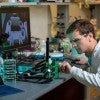
Bite this! Mosquito feeding chamber uses fake skin, real blood
Rice bioengineers teamed up with tropical medicine experts from Tulane to invent a high-tech way to study the feeding behavior of mosquitoes. To eliminate the need for live volunteers, the system uses patches of "synthetic skin" made with a 3D bioprinter.

Pathogenic sensor’s surprising capabilities revealed
Rice synthetic biologists have uncovered new capabilities of a genetically encoded sensor that allows salmonella, E. coli and other pathogens to sicken millions of people each year.
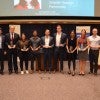
Investors, leaders recognize 11 companies at annual Texas Life Science Forum
Life science innovators, academics and investors – including those specializing in health tech, medical devices and therapeutics – convened at Rice University this week to discuss Houston’s role in the future of health care and give awards to top early-stage life science companies.