

Rice joins global academic network at Venice International University
The VIU Assembly unanimously ratified Rice’s membership in mid-May, making Rice only the third university in the Americas to be welcomed into the association.
Rice joins global academic network at Venice International University
The VIU Assembly unanimously ratified Rice’s membership in mid-May, making Rice only the third university in the Americas to be welcomed into the association.
NSF CAREER Award funds Rice project to shrink hospital-grade imaging into wearable devices
Rice’s Lei Li wins NSF CAREER Award to develop a new generation of wearable medical imaging technology capable of visualizing deep tissue function in real time.

Rice moves up more than 20 spots in QS World University Rankings
Rice has advanced 22 spots in the 2026 edition of the QS World University Rankings, climbing to No. 119 globally and No. 29 among U.S. universities.

Computational biochemist joins Rice with CPRIT recruitment award
Computational biochemist Linna An will join Rice’s Department of Biosciences with support from a $2 million award from the Cancer Prevention and Research Institute of Texas.

Rice bioengineer looks to mitochondria as key to heart failure recovery
Rice bioengineer Mario Escobar has won a Transformational Project Award from the American Heart Association to develop a new therapy for heart failure.

Rice University’s OpenStax partners with Microsoft for AI-enhanced learning
OpenStax, a provider of affordable instructional technologies and the world’s largest publisher of open educational resources, has partnered with Microsoft to integrate its trusted content into Microsoft’s latest learning innovation, Microsoft Learning Zone. Available on Microsoft Copilot+ PCs, Microsoft Learning Zone aims to provide educators and students with responsible AI technology and peer-reviewed educational content to support learning.
Music, memory and the power of emotion: Rice study reveals how music influences what we remember
Rice graduate student and adjunct assistant professor explores how music can help shape new memories.

In an elegant fusion of art and science, researchers at Rice have achieved a major milestone in nanomaterials engineering by uncovering how boron nitride nanotubes (BNNTs) — touted for their strength, thermal stability and insulating properties — can be coaxed into forming ordered liquid crystalline phases in water.

Rice recruits biophysicist to boost cancer research efforts
Rice’s Department of Chemistry will soon welcome Pernilla Wittung-Stafshede.

Rice welcomes 3 new members to board of trustees
Rice University has appointed three distinguished alumni to its board of trustees.

Near-perfect defects in 2D material could serve as quantum bits
Researchers at Rice and collaborators at Oak Ridge National Laboratory and the University of Technology, Sydney report the first demonstration of low noise, room-temperature quantum emitters in h-BN made through a scalable growth technique.
Physicists confirm elusive quantum spin liquid in new study
An international team of scientists led by Rice's Pengcheng Dai has confirmed the existence of emergent photons and fractionalized spin excitations in a rare quantum spin liquid.
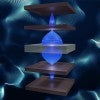
Rice scientists harness vacuum fluctuations to engineer quantum materials
Rice researchers and collaborators have developed a new cavity design that selectively enhances the quantum vacuum fluctuations of circularly polarized light in a single direction, achieving chirality — a feat that typically requires the use of a strong magnetic field.

2025 Kinder State of Housing report finds rising vulnerability and shrinking affordability
The newly released 2025 State of Housing report from Rice’s Kinder Institute for Urban Research, shows rising home prices, surging insurance premiums and growing climate risks are reshaping how and where residents can afford to live.
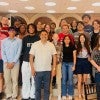
DUNE-TECH boot camp at Rice ignites next generation of America’s neutrino scientists
In a milestone moment for science education and collaboration, Rice hosted its first DUNE-TECH (DUNE Training ExperienCe Hub) camp this June, drawing students, researchers and scientists from across the country into the world of neutrino physics and computing.