Researchers at Rice have uncovered a critical link between rising temperatures and declines in a species’ population, shedding new light on how global warming threatens natural ecosystems.
Thanks to a generous donation from alumnus Dr. Bobby Stinebaugh ’54 and the Stinebaugh family, Rice University is launching the Stinebaugh Family Financial Literacy Program, focusing on personal finance planning and investing, beginning this fall.
A new study led by Rice’s Matthew Schneider-Mayerson reveals that climate change and other environmental issues are notably absent from most popular films despite their increasing urgency.
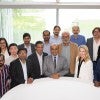
Leaders from Rice Business and the university gathered in the construction area of the business school’s new facility Feb. 28 to celebrate the “topping out” of the building. President Reginald DesRoches, Dean Peter Rodriguez, the advisory board of Rice Business, donors and more signed the beam that will reside in the structure’s highest point to commemorate the moment.
Matt McCary, assistant professor of biosciences at Rice, has been awarded a Faculty Early Career Development (CAREER) Award from the National Science Foundation.
In the race to meet the growing global demand for lithium — a critical component in batteries for electric vehicles — a team of researchers from Rice’s Elimelech lab has developed a breakthrough lithium extraction method that could reshape the industry.
A team of researchers at Rice has developed an innovative AI-enabled, low-cost device that will make flow cytometry ⎯ a technique used to analyze cells or particles in a fluid using a laser beam ⎯ affordable and accessible.
In a breakthrough that could transform bioelectronic sensing, an interdisciplinary team of researchers at Rice University has developed a new method to dramatically enhance the sensitivity of enzymatic and microbial fuel cells using organic electrochemical transistors (OECTs).
Rice neuroscientist Valentin Dragoi and Ariana Andrei from the Houston Methodist Research Institute developed a detailed, step-by-step guide for deploying optogenetics in nonhuman primates, providing critical guidance for researchers working to advance understanding of the brain’s complex networks and their relationship with behavior.
Three former presidential science advisers will speak on how science and technology play a critical role in addressing complex challenges such as climate change, public health, national security and economic competitiveness at a March 8 event hosted by Rice’s Baker Institute for Public Policy. The discussion — free and open to the public — will be complemented by an exhibit inside Baker Hall that displays the history of science advisers and the role of the White House Office of Science and Technology Policy (OSTP) in presidential policymaking.