
Engineering students design field-ready solution for exertional heat stroke
A team of Rice engineering students developed a portable cooling system prototype for managing exertional heat stroke.
Engineering students design field-ready solution for exertional heat stroke
A team of Rice engineering students developed a portable cooling system prototype for managing exertional heat stroke.

Rice and UT Arlington partner to build Hill Country flood warning system
After catastrophic flooding claimed more than 130 lives in Central Texas in July 2025, Rice and the University of Texas at Arlington are partnering to develop a real-time flood warning system aimed at preventing future loss of life.

The GLP-1 paradox: Rice study finds weight loss drugs may carry unexpected stigma
GLP-1 medications have taken over the national conversation around weight loss, but new research from Rice suggests the social reality may be more complicated.

Rice Athletics hosted its annual Night of Flight celebration and fundraiser April 23, bringing together alumni, student-athletes, supporters, family and friends for an evening that highlighted a year of success and the community behind it.

Davis and Rios lead Owls to sweep of UAB
JC Davis and Lorenzo Rios combined to drive in eight runs to lead Rice to a 10-3 win over UAB on Sunday at Reckling Park and complete a sweep of the weekend series by the Owls.

Rice engineering students turn $300 car into dystopian endurance racer
A team of Rice engineering students macgyvered a 1980 Datsun 200 SX into a race-ready vehicle, complete with Orwell-inspired theming.
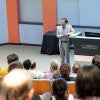
Parthasarathy Ranganathan, vice president and engineering fellow at Google, discussed the rapid evolution of artificial intelligence and the technical and societal challenges shaping its future during the second annual Raleigh White Johnson Jr. Lecture at the George R. Brown School of Engineering and Computing.

Rice students bring health care to rural regions through new app
Three Rice students spent their spring break piloting a mobile health platform designed to support community health workers in underserved regions, including Guatemala, Kenya and Colombia.

The Claudio X. González Center for the U.S. and Mexico at Rice’s Baker Institute for Public Policy convened its second annual U.S. Policy Outlook conference in Mexico City at a moment of heightened political and economic significance for the U.S.-Mexico relationship.

Rice’s Boniuk Institute for the Study and Advancement of Religious Tolerance awarded its 2026 Senior Scholar Award to John Inazu, the Sally D. Danforth Distinguished Professor of Law & Religion and professor of political science at Washington University in St. Louis.

Breaking the silence: At Rice, Black men gather for real conversations on mental health
Hundreds of men gather at Rice for an open conversation about mental health.

For generations of Rice students, Nelson-Campbell was heart of French studies
Deborah Nelson-Campbell spent her scholarly life amplifying silenced medieval women while also being a formative, present voice for her own students.
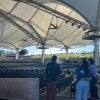
A group of graduate students at Rice is helping shape the long-term sustainability vision for The Cynthia Woods Mitchell Pavilion through a yearlong “Living Lab” collaboration that blends academic research with real-world impact.

A new program at Rice is giving students a front-row seat to the stories shaping Houston and putting them behind a microphone to tell them.

Perovskite solar cells skip yellow phase, degrade slower thanks to key additives
Rice researchers have developed extremely stable perovskite crystalline films for long-lasting, high-efficiency solar cells.