
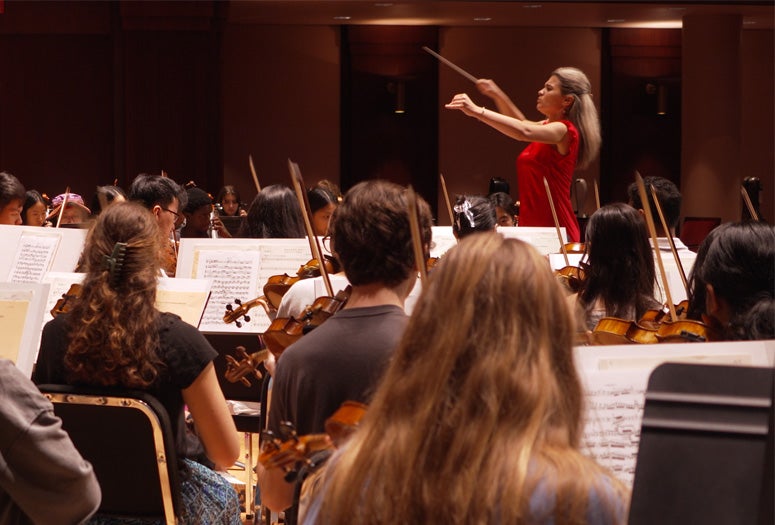
Miguel Harth-Bedoya says the future of music depends on more than technical excellence. It depends on nurturing musicians, educators and music lovers alike — people who understand the power of connection through sound and carry that love of music.
“If it’s in you from the very beginning of your time on Earth, that will remain part of you forever,” said Harth-Bedoya, distinguished resident director of orchestras and professor of conducting at Rice University’s Shepherd School of Music. “These students will be music lovers. Some may turn into professional musicians, but they will be music lovers for the rest of their lives.”
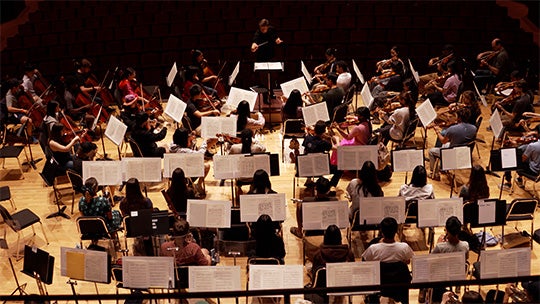
Under Harth-Bedoya’s direction, the Shepherd School revived the Master of Music in Orchestral Conducting, a program that reflects his belief that conducting is not only a craft but also a calling rooted in generosity, listening and lifelong curiosity.
“My first two students are amazing inspirations to me,” Harth-Bedoya said.
The return of the conducting degree also honors the legacy of the late Larry Rachleff, who led the Shepherd School’s conducting program for more than three decades and trained many of today’s leading conductors. Harth-Bedoya now carries that legacy forward, expanding it to reach an even younger generation of musicians beginning with Kyle Haake and Ana Spasovska, the first female conducting student in Shepherd School history. Together, they represent the kind of holistic training Harth-Bedoya envisions — one that values rigor, reflection and community.
“I love the podium because it’s a place where I forget about everything and I think only about one thing: sharing my passion for music,” Spasovska said. “It’s a place where you have 100 people reading as one, 100 people playing something which is written, 100 people going for something and 100 people respecting each other.”
Spasovska, who grew up in Macedonia, first discovered conducting by watching broadcasts of the Macedonian Philharmonic. She admired the conductor’s mystery — “What is this guy in the middle doing?” — before learning that it was far more than waving a baton.
“When I came for the live audition, right before I went on the stage I saw one person. She said to me, ‘You know, we’ve never had a female student until now. I was keeping my fingers crossed so that you pass the audition and you’ll be the first female conducting student,’” Spasovska said. “This gave me so much strength. At the same point, I realized that this is not a coincidence and that I belong here.”
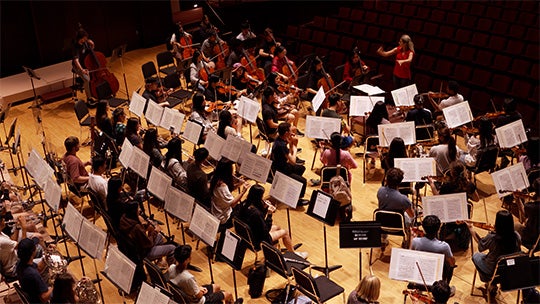
Spasovska’s biggest inspiration and motivation came from her mentor, Romanian conductor and Shepherd School alumnus and distinguished visiting artist Cristian Măcelaru ’06 ’08, who encouraged her to pursue her master’s degree at Rice. Now at the Shepherd School, she says she has found a teacher she had hoped for: a dedicated person who challenges and helps her to grow independently.
“He will never tell me what to do, but he will tell me how to go for it,” Spasovska said. “This is the only way that he can make you remember all the things because otherwise you’re going to find out alone by yourself.”
Haake, who discovered conducting after years as a pianist, shares that same sense of purpose. His passion grew from curiosity into commitment after hearing Riccardo Muti conduct the Chicago Symphony Orchestra.
“I’d always wanted to see an orchestra concert, and when I was in fourth grade my parents surprised me with tickets for Christmas,” Haake said. “I remember the program was the Berg Violin Concerto and Stravinsky’s ‘Rite of Spring,’ music that I had no idea existed.”
Now his days at the Shepherd School revolve around study, observation, rehearsal and conducting mechanics. Mondays, Wednesdays and Fridays are spent studying the music and observing the orchestra; Tuesdays and Thursdays are dedicated to intense physical and mechanical training; and Saturdays bring hands-on experience conducting the Campanile Orchestra, a campuswide ensemble of nonmusic majors, alongside Spasovska and Harth-Bedoya.
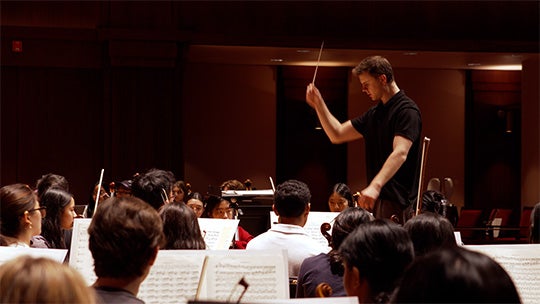
“It’s an amazing opportunity to get to study with Miguel,” Haake said. “Every week is just a new adventure.”
Beginning next fall, the Shepherd School will launch the nation’s only Bachelor of Music in Orchestral Conducting, a program designed to provide the kind of long-term, immersive foundation that Harth-Bedoya believes is essential to true mastery.
“What I call the ‘premed of conducting’ is the bachelor in conducting, so that when you do your master’s, you can really master something that you have built to do rather than start studying conducting at the master’s level,” Harth-Bedoya said.
For Harth-Bedoya, it all comes back to the same conviction that has guided his career and his teaching: Music must be passed forward through mentorship, education and love.
“The future of music is us professionals training performers, training music teachers and, more importantly, training music lovers,” Harth-Bedoya said. “If we do this at all times, then we can only guarantee that there will be a future for music.”