
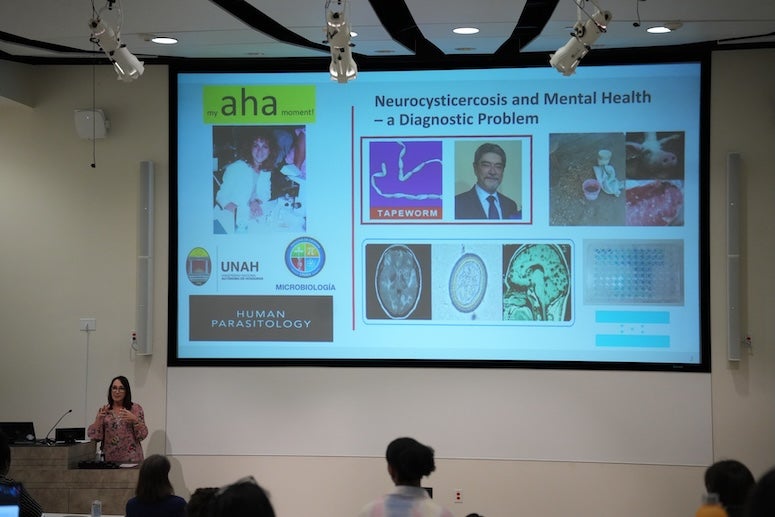
Maria Elena Bottazzi, an internationally recognized vaccine scientist and advocate for equitable access to global health innovations, delivered the Oct. 21 lecture in the Rice360 Institute for Global Health Technologies seminar series. Her talk, “Tropical Medicine and the Vaccine Sciences: Translational Synergies Integrated with Social, Economic and Policy Perspectives,” explored how vaccine development bridges the gap between scientific discovery and public health impact.
Bottazzi, co-director of the Texas Children’s Hospital Center for Vaccine Development and professor of pediatrics, molecular virology and microbiology at Baylor College of Medicine, shared lessons from two decades of translating vaccines for neglected tropical diseases and emerging infections from concept to delivery. She described the complex scientific, regulatory, financial and operational elements that shape the “translational research and development case” — the foundation for advancing vaccines through the so-called “valley of death” between discovery and licensure.
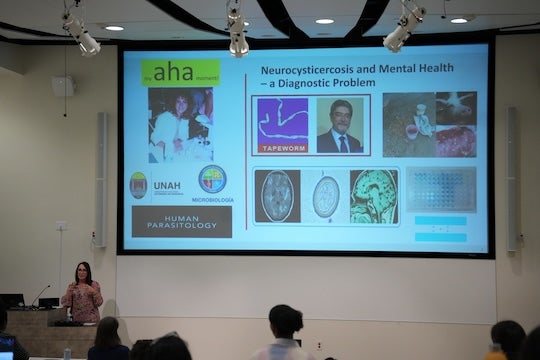
Her presentation highlighted how strong translational frameworks can yield vaccines with measurable public health benefits and economic sustainability, particularly for low- and middle-income countries. Bottazzi also discussed her team’s pioneering use of open science to promote global vaccine equity, including the co-development of low-cost COVID-19 vaccines that have delivered more than 100 million doses worldwide.
“Developing the tool just with the scientific premise is not enough,” Bottazzi said. “… The societal perspective is very important, the marketing, the monetary [aspect] and being very clear about your intentions to support the public good.”
Bottazzi, a member of the U.S. National Academy of Medicine and recipient of the Vilcek-Gold Award for Humanism in Healthcare, is widely regarded for her leadership in advancing vaccines for diseases such as hookworm, schistosomiasis and Chagas disease. Her work exemplifies the intersection of scientific excellence, social responsibility and innovation in global health.
The Rice360 Institute for Global Health Technologies, a leader in global health education and research at Rice University, launched the seminar series to engage campus and community audiences in conversations with experts working across medicine, technology and policy to improve health outcomes worldwide.
The next seminar in the series will take place Dec. 2 from 5-6:15 p.m. in Room 280 at the BioScience Research Collaborative and will feature Queen Dube, the newborn health program lead at the World Health Organization.
Dube’s talk, “Turning Crisis into Catalyst: Innovating the Global Health Architecture for Newborn Survival,” will examine how overlapping global crises — from pandemics and climate stress to fragile health systems — have exposed weaknesses in newborn care delivery and financing. She will discuss how innovation, governance reform and collaborative models can help reimagine global health systems to ensure every newborn not only survives but thrives.
A pediatrician and clinical epidemiologist, Dube has worked with the Ministry of Health, Saving Newborn Lives, Pediatrics and Child Health Association of Malawi and UNICEF to improve the quality of newborn care in district hospitals and to improve the quality of care for the small and sick newborn in Malawi. She took a leading role in the development and implementation of the Every Newborn Action Plan for Malawi, identifying challenges in neonatal care and implementing new technical solutions at various hospitals in the country.
Learn more about the speakers and seminar series at rice360.rice.edu/glht-seminar-series.