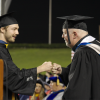
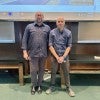
David Tenney stood onstage at Rice Stadium Saturday, handing out diplomas to graduating students one by one. Rice’s undergraduate commencement ceremony is an event he knows well, having not only received his degree from Rice in 1987 but also having worked as the university’s registrar for two decades. But this time was different. A special moment he’d been waiting for was finally here: His son Jonathan Tenney was among the graduates.
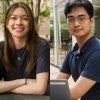
Rice University students Emma Codianne and Daniel Wang have won the Barry Goldwater Scholarship , an annual award that recognizes pioneering science, technology, engineering and mathematics (STEM) undergraduates in the United States.
Rice University senior Ryan Wang has been selected as a recipient of the Knight-Hennessy Scholarship, marking a significant milestone in his academic journey. The scholarship will enable him to pursue graduate studies at Stanford University, where he will probe deeper into bioengineering with a focus on neuroscience.
Researchers at Rice University have successfully synthesized a group of natural compounds known as fusicoccanes. The molecules, found in various living organisms, exhibit diverse biological activities, including the ability to modulate protein-protein interactions within biological systems.
Team Heartbeat HERoes claimed victory at Rice University’s Oshman Engineering Design Kitchen’s (OEDK) annual Huff OEDK Engineering Design Showcase last month. The team secured the 2024 Woods-Leazar Innovation Award along with a $5,000 cash prize for its project in medical engineering.
Rice University and the Houston Independent School District (HISD) will collaborate on a space and planetary science pilot program to inspire the next generation of Earth, planetary and space enthusiasts and professionals.
Rice University will host its 2024 Carbon Hub Annual Meeting May 6-7. The two-day event set to take place on campus promises a dynamic lineup of panel discussions, technical sessions, networking opportunities and roundtable meetings with experts from industry, academia and foundations.
Rice University’s Synthesis X Center (SynthX) and Baylor College of Medicine’s Dan L Duncan Comprehensive Cancer Center have jointly awarded their first innovation seed grants to three teams of research collaborators from Rice and Baylor.
Rice University bioscientist Yousif Shamoo has been elected a fellow of the American Association for the Advancement of Science (AAAS), the world’s largest general scientific society and publisher of the journal Science.
When Trinity Eimer, a senior at Rice University, applied for the prestigious one-year postgraduate Thomas J. Watson Fellowship last September, she knew exactly what project to pitch to the evaluation committee. The cell biology and genetics major began her college career during the COVID-19 pandemic and wanted to spend her next 12 months studying the cross-cultural impact of grief caused by it.
Alan Reid, the Edgar Odell Lovett Professor of Mathematics and mathematics department chair at Rice University, has been elected to the Royal Society of Edinburgh (RSE), Scotland’s National Academy of Science and Letters. The prestigious accolade bestowed annually celebrates individuals who have achieved exceptional international standing in fields within the society’s domain.
Rice University hosted the inaugural Natural Sciences Undergraduate Research Symposium April 11 in a celebration of research across various natural sciences disciplines.
Megan Reiter, an assistant professor of physics and astronomy at Rice University, has won a National Science Foundation (NSF) CAREER Award to investigate the influence of neighboring stars on the formation of planets.
In a recent lecture titled “Climate Resilience and Urban Design,” Rice University professors Dominic Boyer and Albert Pope shed light on the hydrological and infrastructural challenges Houston faces. That includes flooding triggered by the impacts of climate change, the duo said, as they discussed the need for sustainable solutions at the recent Scientia Institute Lecture Series event in the Kyle Morrow Room at Fondren Library.
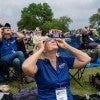
As the moon completely eclipsed the sun April 8, more than 300 Rice University alumni, faculty and staff gathered on the lawn of the Flying L Ranch Resort in Bandera, Texas, to view the last total solar eclipse in the contiguous United States for the next two decades.