
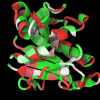
Do genes-in-pieces code for proteins that fold in pieces?
A new study led by Peter Wolynes offers new insights into the evolution of foldable proteins.
Do genes-in-pieces code for proteins that fold in pieces?
A new study led by Peter Wolynes offers new insights into the evolution of foldable proteins.

New CPRIT chemistry professor to enhance cancer research at Rice
Rice’s Department of Chemistry will soon welcome Professor David Sarlah.
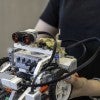
Team Ryu triumphs at International Space University’s robotics competition
Team Ryu took home first place at the ISU space-themed robotics competition.
Researchers discover new flat electronic bands, paving way for advanced quantum materials
A team of scientists led by Qimiao Si predicts the existence of flat electronic bands at the Fermi level.

Researchers pioneer noninvasive gene therapy for brain disorders
A new method developed by a research team led by Jerzy Szablowski offers hope for treating brain disorders through gene therapy.
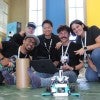
Rice to host ISU space robotics competition June 21
Space industry professionals from around the world are set to compete in a space-themed robotics competition at Rice.
Rice lab achieves major gains in perovskite solar cell stability
Rice lab develops new chemistry to achieve commercially relevant stability and performance for perovskite solar cells.

More than 200 space industry professionals gathered at Rice for the opening ceremony of the International Space University’s Space Studies Program.
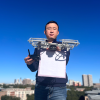
Discovery highlights ‘critical oversight’ in perceived security of wireless networks
A research team led by Edward Knightly has uncovered an eavesdropping security vulnerability in high-frequency and high-speed wireless backhaul links.
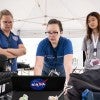
A team from Rice participated in the NASA Spacesuit User Interface Technologies for Students program.
Rice researchers uncover surprising role of opioid receptors in gut development
Researchers at Rice have revealed a previously unknown function of opioid receptors in the development of the enteric nervous system.

Rice chemist Gustavo Scuseria wins 2024 Schrödinger Medal
Pioneering Rice chemist Gustavo Scuseria has won the 2024 Schrödinger Medal from the World Association of Theoretical and Computational Chemists.

Swedish delegation visits Rice campus with eye on space exploration
A delegation from Sweden visited Rice to forge new pathways for collaboration and growth in space education and research.

Rice researchers stride to unlock mysteries of human development
A research team from Rice University led by Aryeh Warmflash has made strides in understanding the processes that guide human embryonic development. The group’s findings were published in the scientific journal Cells Systems May 15.
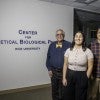
Rice study reveals insights into protein evolution
Rice University’s Peter Wolynes and his research team have unveiled a breakthrough in understanding how specific genetic sequences, known as pseudogenes, evolve. Their paper was published May 13 by the Proceedings of the National Academy of Sciences of the United States of America Journal.