

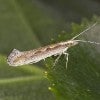
Crop-eating moths will flourish as climate warms
Climate change in this century will allow one of the world's costliest agricultural pests, the diamondback moth, to both thrive year-round and rapidly evolve resistance to pesticides in large parts of the United States, Europe and China where it previously died each winter, according to a study by U.S. and Chinese researchers.

Rice physicists find 'magnon' origins in 2D magnet
Rice physicists have confirmed the topological origins of magnons, magnetic features they discovered three years ago in a 2D material that could prove useful for spintronics.
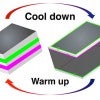
Physicists find room-temperature, 2D-to-1D topological transition
Physicists have discovered a room-temperature transition between 1D and 2D electrical conduction states in the topological insulator bismuth iodide.

Trailblazing Rice bioengineer is turning cells into disease fighters
Rice University bioengineer Isaac Hilton has been awarded an NIH Trailblazer Award to create synthetic circular DNA that can be used to reprogram cells as disease fighters.

National 2D materials research center wins NSF funding
Rice, Penn State and Boise State have won a federal grant to expand ATOMIC, a national research center that develops atom-thin 2D coatings via university, industry and government partnerships.
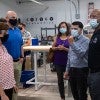
DesRoches, Nakhleh, others tour startup Syzygy Plasmonics
Rice's provost, dean of engineering and others toured chemical manufacturing startup Syzygy Plasmonics last week.

Rice expert: Using carbon is key to decarbonizing economy
Rice University carbon materials expert Matteo Pasquali is available to discuss ways to slash carbon dioxide emissions and rapidly decarbonize the global economy.
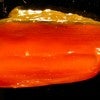
Data scientists go to the mat to learn about microbial networks
A project led by Rice University data scientists will attempt to define "social networks" in microbiomes, starting with microbial mats that thrive in Yellowstone Park's hot springs.
When many act as one, data-driven models can reveal key behaviors
Data science approaches can reveal subtle clues about the origins of such collective behaviors as aggregation of bacteria.

NSF grant kicks off Center for Adapting Flaws into Features
Rice University has won a Phase I National Science Foundation grant to establish the NSF Center for Adapting Flaws into Features to investigate nanoscale chemical phenomena and optimize the structures and electronic properties of materials.
How headless hydra feel, react to prodding
Researchers identify redundant neural networks in jellyfish-like, freshwater hydra. The work is a step toward modeling how internal states and external stimuli shape the behavior of an organism with a highly dynamic neural architecture.

Vardi wins award for social and professional responsibility
Rice computer scientist Moshe Vardi has won the 2021 Norbert Wiener Award for Social and Professional Responsibility from IEEE's Society on the Social Implications of Technology.
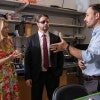
Rep. Dan Crenshaw hosts health care summit, tours neuroengineering labs
U.S. Rep. Dan Crenshaw (left), R-Texas, hosted his third annual Healthcare Innovation Summit July 23 at Rice University's BioScience Research Collaborative (BRC) in conjunction with the university's Institute of Biosciences and Bioengineering.
Rice team creating insulin-producing implant for Type 1 diabetes
Rice University bioengineers are using 3D printing and smart biomaterials to create an insulin-producing implant for Type 1 diabetics.