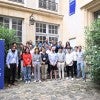
The Rice Center for Quantum Materials hosted a workshop on quantum materials synthesis at the Rice Global Paris Center, bringing together global researchers in physics, materials science, chemistry and quantum research to identify new directions and address urgent challenges facing the quantum materials synthesis community.
A Rice-led conference in Paris convened global experts in cavity quantum electrodynamics to explore new approaches to controlling light-matter interactions and advancing quantum technologies.
The PSL Global Seed Fund operates less like a grant program and more like a catalyst sparking collaborations that bridge disciplines and extend Rice’s reach across continents.
Rice computer scientists have developed algorithms that account for quantum noise that is not just random, but malicious interference from an adversary.
A team of Rice researchers has developed a new way to control light interactions using a specially engineered structure called a 3D photonic-crystal cavity that could enable transformative advancements in quantum computing, quantum communication and other quantum-based technologies.
A multidisciplinary team of researchers from Rice and Texas A&M has received a $1.2 million award from the W.M. Keck Foundation to advance super-resolution imaging and single-molecule tracking by harnessing super-radiance, a quantum optical phenomenon with transformative potential for research and innovation in medicine, engineering and the physical sciences.
In a paper recently published in Nature Physics , an international group of researchers have found evidence of a quantum spin liquid in a material known as pyrochlore cerium stannate.
Rice’s Center for Quantum Materials and Smalley-Curl Institute recently held two successive events aimed at advancing the field of quantum materials research.
A research traineeship program developed by a team of Rice faculty led by Junichiro Kono has received an award of $3 million over five years from the National Science Foundation to equip a new generation of scientists and engineers with the skills needed to serve as leaders in quantum technology innovation.
The Rice Center for Quantum Materials recently hosted the second edition of the Workshop on Quantum Materials Synthesis, an event dedicated to communicating recent developments in the field, identifying new research areas and providing a platform for theorists and experimentalists to come together for discussion and knowledge exchange.
Rice physicists have discovered a phase-changing quantum material — and a method for finding more like it — that could potentially be used to create flashlike memory capable of storing quantum bits of information, or qubits, even when a quantum computer is powered down.
A team of researchers from Rice University and the University of Illinois Urbana-Champaign has shown that molecules can be as formidable at scrambling quantum information as black holes by combining mathematical tools from black hole physics and chemical physics and testing their theory in chemical reactions.
Rice engineers have demonstrated a way to control the optical properties of an atomic imperfection in silicon material known as a T center by embedding it in a photonic integrated circuit and exploiting the Purcell effect to strengthen light-matter interaction and increase the rate of spontaneous emission.