
Quantum materials are materials whose properties are governed by quantum mechanics, the rules that describe how matter behaves at the smallest scales. These materials could help shape future technologies in computing, sensing, energy, electronics and communications, but discovering and synthesizing them requires expertise across disciplines and international collaboration.
“Quantum technologies are often framed around communication, sensing and computing, but none of those fields can move forward without the right materials,” said Emilia Morosan, director of the Rice Center for Quantum Materials and trustee professor of physics and astronomy. “Quantum materials are the foundation. They determine what kinds of quantum states we can create, how long those states can last and how reliably we can use them in real devices.”
Leading researchers from around the world gathered in Paris June 9-12 for the 2026 Rice Center for Quantum Materials and Korean Academy of Science and Technology InterAcademy Global Workshop on Quantum Materials Synthesis, a four-day meeting focused on advancing one of the most important frontiers in modern materials research.
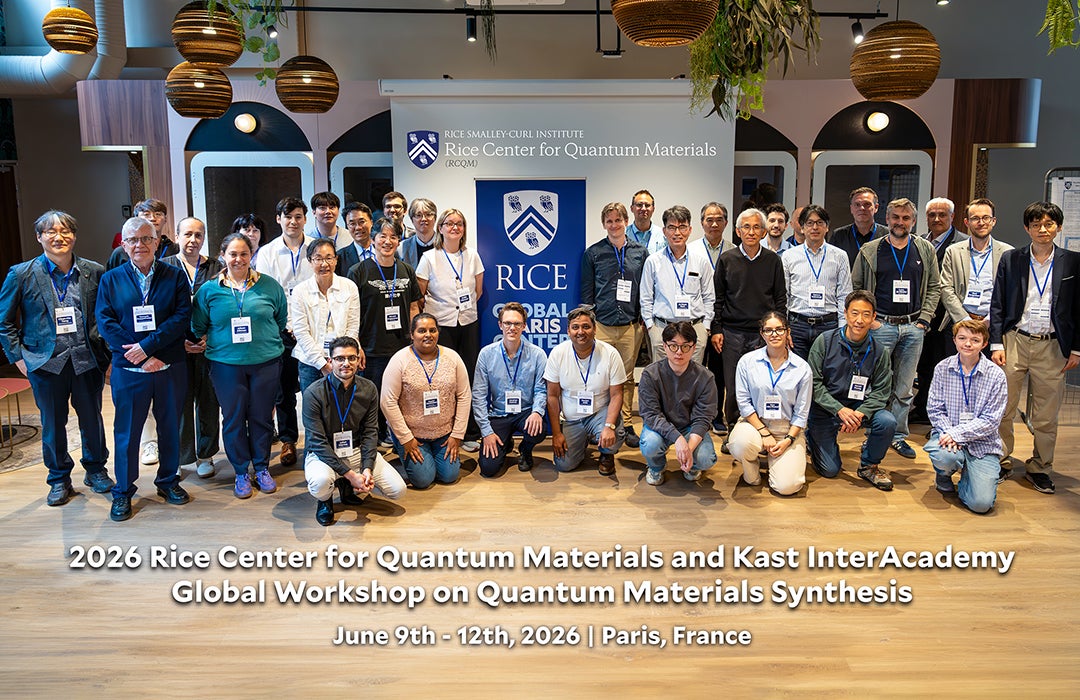
Hosted at the Rice Global Paris Center, the workshop brought together physicists, materials scientists, chemists, experimentalists and theorists to share recent developments, identify new research directions and address urgent challenges facing the quantum materials synthesis community.
The workshop was designed as an interdisciplinary forum for researchers working across a wide range of synthesis techniques and scientific questions. Sessions covered topics including topological materials, superconductivity, magnetism, ferroelectrics, quantum defects, advanced microscopy and computational approaches to materials discovery.
A truly global gathering brought together speakers from institutions across the United States, South Korea, Japan, Sweden, Croatia, France and Germany, including Rice, Texas A&M University, Brown University, Carnegie Mellon University, Rutgers University, Stanford University, Northwestern University, the University of California, Santa Barbara, the University of Colorado Boulder, Seoul National University, Pohang University of Science and Technology, Kyoto University, the University of Tokyo, Chalmers University of Technology, the University of Zagreb and the Max Planck Institute for Chemical Physics of Solids.
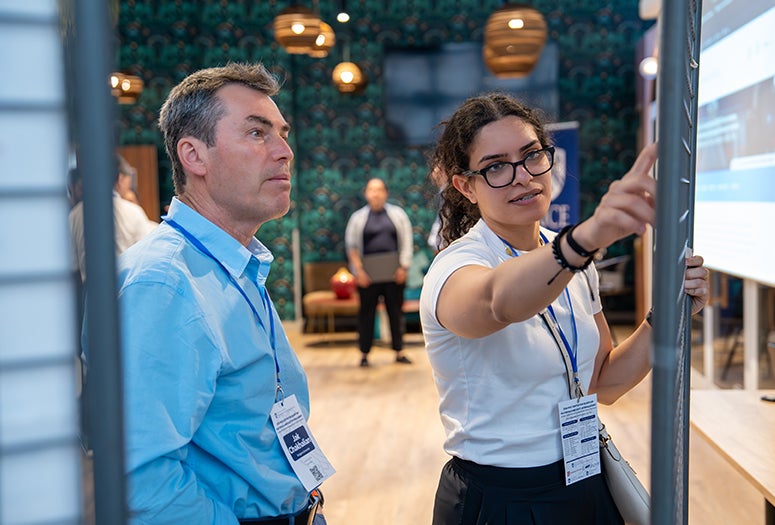
In addition to scientific talks, the workshop included a poster session, group discussions and a panel session focused on how the field can address barriers in synthesis, characterization and collaboration.
A key goal of the workshop was to support young scientists entering the field. By bringing graduate students, postdoctoral researchers and early career scientists into direct conversation with established global leaders, the event aimed to promote educational and career opportunities in modern materials synthesis.
“Workshops like this are essential because they connect the people who make materials, measure them, model them and imagine what they could become,” Morosan said. “For students and early career researchers especially, these conversations can shape the questions they ask and the collaborations they pursue for years to come.”
The meeting reflects Rice’s growing global engagement in quantum materials research and the university’s commitment to convening international scientific communities around major research challenges. It also builds on the Rice Center for Quantum Materials’ mission to foster interdisciplinary research into materials with unusual electronic, magnetic and optical properties.
The workshop was sponsored by the Rice Center for Quantum Materials, the Korean Academy of Science and Technology, the Quantum Foundry at University of California, Santa Barbara, Quantum Design, the Smalley-Curl Institute and Rice Global.