
When Junichiro Kono spent a month at the École Normale Supérieure (ENS) in Paris, he didn’t just advance his research in quantum science — he helped expand Rice’s role in a growing network of collaboration between Houston and Paris.
“The Université Paris Sciences & Lettres (PSL) Global Seed Fund was truly valuable for fostering connections between Rice and PSL,” said Kono, the Karl F. Hasselmann Chair in Engineering and director of the Smalley-Curl Institute. “Using the funds, I spent a month at ENS, where I met many exciting researchers and began several ongoing collaborations. After returning to Rice, I was also able to connect some of those PSL researchers with colleagues here, strengthening the Rice-PSL partnership.”
Kono’s project linked Rice’s Quantum Initiative with PSL’s research network in quantum science and engineering — one of four shared priority areas outlined in the memorandum of understanding the two institutions signed in 2024. The others — urban futures, global health and energy transition — reflect the full spectrum of Rice expertise that the fund is designed to support.
That breadth is already visible. A $15,000 grant helped launch Reimagining Health and the Logics of Digital Care, a transatlantic conference co-organized by Rice’s Medical Humanities Research Institute and PSL partners including the Institut Santé Numérique en Société. The gathering at the Rice Global Paris Center explored how data-driven technologies are reshaping reproductive healthcare, ethics and patient experience.
“The funding provided logistical and planning support, a beautiful and well-equipped meeting space, monetary support to help pay for meals and publicity (photography and filming) during the event,” said MHRI director Kirsten Ostherr. “The financial support was very helpful, but the logistical support was even more valuable, as it would be challenging to coordinate all of the details involved in hosting a two-day event without RGP staff on the ground in Paris to help us make arrangements.”
The exchange works both ways. The PSL Global Seed Fund is also enabling PSL faculty to visit Rice in Spring 2026 to build on the work started by the Paris conference.
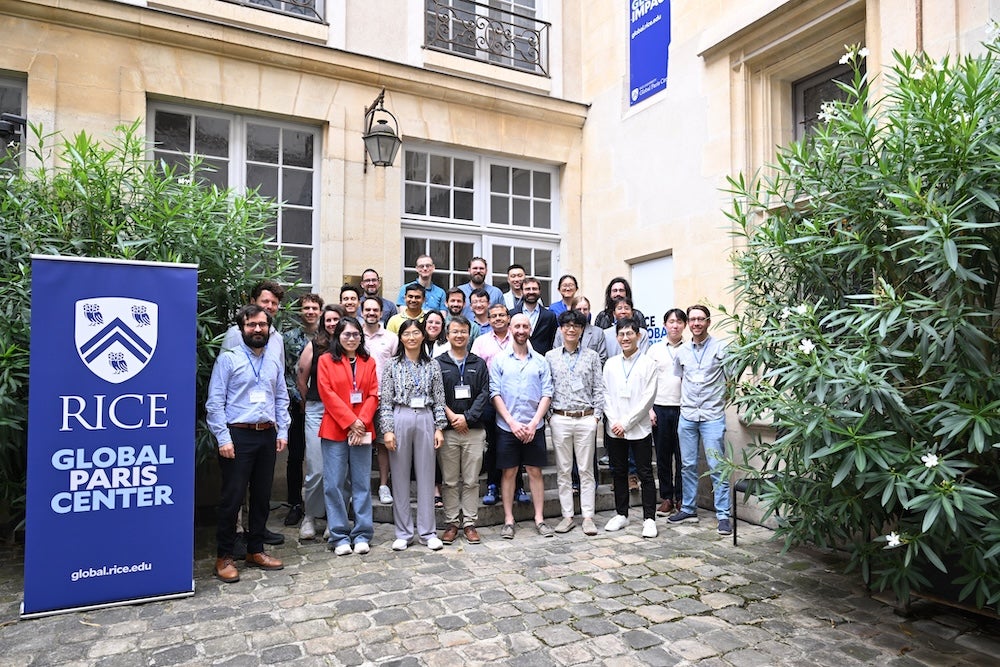
Another $15,000 award made possible the Young Research Leaders in Topological Materials and Beyond workshop held at the Paris Center. The event convened emerging scholars and established experts in one of Rice’s fastest-growing research areas, reinforcing the university’s position as a global hub for materials innovation.
“The PSL Global Seed Fund was key to launching the Young Research Leaders in Topological Materials and Beyond workshop,” said Yonglong Xie, assistant professor of physics and astronomy. “It allowed Rice and PSL faculty to co-create a truly international platform that brings together the next generation of quantum materials scientists — and exemplifies the deep, growing partnership between our two institutions.”
Together, these projects show how the PSL Global Seed Fund operates less like a grant program and more like a catalyst sparking collaborations that bridge disciplines and extend Rice’s reach across continents.
Full-time Rice faculty are encouraged to apply for the next round of the PSL Global Seed Fund, which closes Nov. 16. Eligible activities include research stays, conferences, workshops and exploratory collaborations. Interested faculty should contact Rice Global for application instructions.