
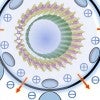
Double-walled nanotubes have electro-optical advantages
Rice theorists find that flexoelectric effects in double-walled carbon nanotubes could be highly useful for photovoltaic applications.
Double-walled nanotubes have electro-optical advantages
Rice theorists find that flexoelectric effects in double-walled carbon nanotubes could be highly useful for photovoltaic applications.
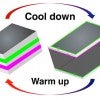
Physicists find room-temperature, 2D-to-1D topological transition
Physicists have discovered a room-temperature transition between 1D and 2D electrical conduction states in the topological insulator bismuth iodide.

Odd angles make for strong spin-spin coupling
HOUSTON – (May 25, 2021) – Sometimes things are a little out of whack, and it turns out to be exactly what you need.

Pristine quantum criticality found
U.S. and Austrian physicists searching for evidence of quantum criticality in topological materials have found one of the most pristine examples yet observed.

Rice team vying for $1 million Solar Desalination Prize
A Rice team's clever design uses the power of the sun to make fresh water from saltwater, even at night.
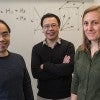
Quantum quirk yields giant magnetic effect, where none should exist
In a twist befitting the strange nature of quantum mechanics, physicists have discovered the Hall effect — a characteristic change in the way electricity is conducted in the presence of a magnetic field — in a nonmagnetic quantum material to which no magnetic field was applied.

Theory could accelerate push for spintronic devices
A theory by Rice scientists could boost spintronics, a key to creating faster and more powerful electronic devices, including quantum computers.

Research could dramatically lower cost of electron sources
Rice University engineers have discovered technology that could slash the cost of semiconductor electron sources, key components in devices ranging from night-vision goggles and low-light cameras to electron microscopes and particle accelerators.
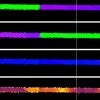
Boundaries no barrier for thermoelectricity
Rice researchers show how thermoelectricity hurdles some defects, but not others, in gold nanowires. The discovery has implications for making better thin-film electronic devices.

Quantum leap for speed limit bounds
Nature's speed limits aren't posted on road signs, but Rice University physicists have discovered a new way to deduce them that is better — infinitely better, in some cases — than prior methods.
Largest gift in Rice history establishes The Welch Institute
The Robert A. Welch Foundation announces the largest single gift in the history of Rice University, $100 million, to establish The Welch Institute for world-leading advanced materials research.
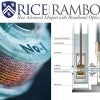
Rice’s RAMBO-II: A sequel better than the original
First-of-its-kind spectrometer is getting stronger magnets, wider range of lasers.
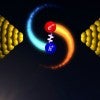
Rice lab’s bright idea is pure gold
Physicists discover plasmonic metals can produce “hot carriers” that emit unexpectedly bright light in nanoscale gaps between electrodes.
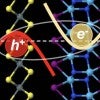
Excitons form superfluid in certain 2D combos
Mixing and matching computational models of 2D materials led scientists at Rice University to the realization that excitons can be manipulated in new and useful ways.

Rice U. physicist Ming Yi wins coveted Moore Foundation grant
Rice physicist Ming Yi won $1.6 million from the Gordon and Betty Moore Foundation for high-risk, high-reward research into quantum materials.