In a paper recently published in Nature Physics , an international group of researchers have found evidence of a quantum spin liquid in a material known as pyrochlore cerium stannate.
Rice’s Center for Quantum Materials and Smalley-Curl Institute recently held two successive events aimed at advancing the field of quantum materials research.
The eQMA Workshop on Quantum Materials and Entanglement brought together more than 100 experts and attendees from across the globe to discuss advancements in quantum research.
Rice’s Smalley-Curl Institute held its 38th annual Summer Research Colloquium Aug. 2 at Rice’s Duncan Hall, where undergraduate and graduate students and postdoctoral researchers gave presentations covering topics in nanoscience, quantum materials and quantum information science and technology to a multidisciplinary audience.
The Rice Center for Quantum Materials recently hosted the second edition of the Workshop on Quantum Materials Synthesis, an event dedicated to communicating recent developments in the field, identifying new research areas and providing a platform for theorists and experimentalists to come together for discussion and knowledge exchange.
Rice scientists have discovered a first-of-its-kind material, a 3D crystalline metal in which quantum correlations and the geometry of the crystal structure combine to frustrate the movement of electrons and lock them in place.
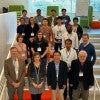
An international audience of more than three dozen quantum researchers, including Rice’s Pengcheng Dai, Randall Hulet, Douglas Natelson, Han Pu, Ming Yi and Boris Yakobson, attended the Vannevar Bush Faculty Fellowship Symposium on Extreme Quantum Materials at Rice Nov. 9.
Rice experiments have provided the first direct evidence that electricity seems to flow through “strange metals” in an unusual liquid-like form. The first “shot noise” experiments on a strange metal from the Vienna University of Technology (TU Wien) are detailed this week in Science by physicists from both universities.
Rice alumnus Louis Brus (’65) has been awarded the Nobel Prize in Chemistry alongside Moungi Bawendi and Alexei Ekimov for the “discovery and development of quantum dots.”
In a potential boon for quantum computing, Rice physicists have shown that topologically protected quantum states can be entangled with other, highly manipulable quantum states in some electronic materials.
Rice University researchers leverage the quantum properties of strontium titanate to make a broad terahertz frequency range useful for quantum control and sensing applications.