With federal research funding in the headlines in recent months, Rice's Office of Public Affairs is spotlighting what’s at stake — and what’s possible — by putting the university’s research enterprise front and center on its newly updated homepage.
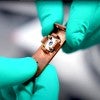
A new study led by researchers from the Department of Materials Science and NanoEngineering at Rice has introduced an innovative solution that could impact electrochemical energy storage technologies.
As India’s influence grows in fields such as climate change, biotechnology and artificial intelligence, Rice is positioning itself to be a key collaborator.
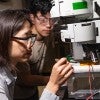
Rice researchers have developed a new machine learning algorithm that excels at interpreting optical spectra, potentially enabling faster and more precise medical diagnoses and sample analysis.
Rice professors Karen Lozano and Eduardo Salas have been elected to the American Academy of Arts and Sciences, one of the oldest and most prestigious learned societies in the nation.
Student engineering teams at Rice demonstrated how hands-on design can drive real-world impact at the 2025 Huff OEDK Showcase and competition. Held April 17 at the Ion, the event featured 81 student teams, 93 judges and hundreds of visitors.
Hosted by the School of Humanities, the annual Kazimi Lecture honors the memory of Syed Safdar and Samina Kazimi by inviting artists and scholars whose work deepens understanding of Shi’i Islam.
In a city defined by innovation and resilience, the Rice Water Technologies Entrepreneurship and Research (WaTER) Institute hosted its distinguished lecture and panel discussion in Houston April 16, drawing together industry leaders, venture capitalists, researchers and aspiring entrepreneurs to tackle one of the most urgent challenges of our time: water.
Following Pope Francis’ death, Craig Considine, a senior lecturer in sociology at Rice, scholar of religion and interfaith dialogue is available to discuss the late pontiff’s life and legacy.
A team of Rice researchers has developed a new way to control light interactions using a specially engineered structure called a 3D photonic-crystal cavity that could enable transformative advancements in quantum computing, quantum communication and other quantum-based technologies.
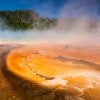
A team of researchers from Rice, University of New Mexico, University of Utah and the University of Texas at Dallas have discovered a sharp, volatile-rich cap just 3.8 kilometers beneath Yellowstone’s surface.