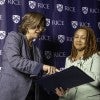
Texas state Rep. Ann Johnson, whose legislative district includes Rice University, visited campus Feb. 29 to present resolutions from the 88th Texas Legislative session to Rice faculty, researchers and alumni.
NASA has released the first stunning images of the Orion Nebula from the James Webb Space Telescope in a study in the journal Science that shows with unprecedented precision how massive stars impact the formation of planetary systems.
The Wiess School of Natural Sciences at Rice University has launched the Center for Nanoscale Imaging Sciences to improve the capture, analysis and interpretation of images at the nanometer scale. The center will push the frontiers of nanoscale imaging, contributing to breakthroughs in fields such as nanotechnology, materials science, biology and biomedicine.
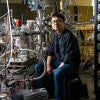
Yonglong Xie, assistant professor of physics at Rice University, has been awarded a Faculty Early Career Development (CAREER) Award from the National Science Foundation (NSF). The $888,555 grant over five years will support Xie’s research into harnessing magnons, quantum mechanical wavelike objects in magnetic materials, to create synthetic matter and develop next-generation quantum devices and sensors.
Rice researchers have developed a new, energy-efficient upcycling method to transform glass fiber-reinforced plastic (GFRP) into silicon carbide, widely used in semiconductors, sandpaper and other products.
The centers are the Rice Center for Nanoscale Imaging Sciences, Synthesis X Center, Center for Environmental Studies, Center for Latin American and Latinx Studies, and Center for Coastal Futures and Adaptive Resilience.
Rice chemist James Tour was named to the National Academy of Engineering, one of the highest professional distinctions accorded “in recognition of distinguished contributions” to the field.
Rice University chemist Bruce Weisman’s three-decade career in nanocarbons research has been honored with the namesake award of the Rice colleague who founded the field and sparked Weisman’s interest in it.
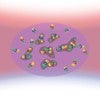
A team of Rice researchers mapped out how flecks of 2D materials move in liquid ⎯ knowledge that could help scientists assemble macroscopic-scale materials with the same useful properties as their 2D counterparts.
Rice scientists have discovered a first-of-its-kind material, a 3D crystalline metal in which quantum correlations and the geometry of the crystal structure combine to frustrate the movement of electrons and lock them in place.
A new study by Rice researchers found that graphene derived from metallurgical coke, a coal-based product, through flash Joule heating could serve not only as a reinforcing additive in cement but also as a replacement for sand in concrete.
Rice University researchers in the lab of chemist Han Xiao have identified a promising new immunological pathway to treat stubborn bone tumors, one of most prevalent forms of metastases in breast cancer patients.
Rice scientists along with collaborators at Durham University prolonged quantum behavior in an experimental system nearly 30-fold by using ultracold temperatures and special laser wavelengths to generate a “magic trap” that delays the onset of quantum decoherence.
Rice University and Woodside Energy today announced a ground-breaking five-year technology collaboration aimed at reducing greenhouse gas emissions and providing lower carbon solutions.
The Rice Synthetic Biology Institute aims to catalyze collaborative research in synthetic biology and its translation into technologies that benefit society.