
Common food bacteria could help make vitamins cheaper, greener
A new study reveals how L. lactis regulates the production of a key precursor in vitamin K₂ biosynthesis.
Common food bacteria could help make vitamins cheaper, greener
A new study reveals how L. lactis regulates the production of a key precursor in vitamin K₂ biosynthesis.

Niamh Ordner is spending her summer as an American Association for the Advancement of Science (AAAS) Mass Media Science and Engineering Fellow at the Los Angeles Times, where she’s writing science stories that aim to make complex topics accessible, relevant and exciting.

Rice bioscientist wins NSF CAREER Award to investigate bacterial toxins, expand inclusion in STEM
Marcos de Moraes, assistant professor of biosciences at Rice, has been awarded a grant from the National Science Foundation Faculty Early Career Development Program.

Superconductivity’s halo: Rice theoretical physicist helps map rare high-field phase
Rice's Andriy Nevidomskyy is part of a team that has mapped and explained a puzzling form of superconductivity that arises only under strong magnetic fields.

‘Major leap in bioelectronic sensing’: Rice researchers turn bacteria into tiny pollution detectors
A study led by Xu Zhang, Marimikel Charrier and Caroline Ajo-Franklin demonstrates an innovative method for the real-time, on-site detection of arsenite and cadmium.

Bats, poaching and the pulse of the forest: Rice researchers lead biodiversity study in Tanzania
Deep in the heart of Tanzania’s Udzungwa Mountains, a trio of Rice researchers embarked on an ambitious summer field study to understand how human impacts are reshaping forest ecosystems.
Rice, Baylor College of Medicine award seed grants for cancer research
Rice's Synthesis X Center and Baylor College of Medicine’s Dan L Duncan Comprehensive Cancer Center have awarded the second offering of a two-year seed grant program.

Physicists unlock hidden order in twisted graphene, paving way for supermoiré engineering
A new study by applied physicists used a custom-designed microscope to examine supermoiré patterns in trilayer graphene.
Why some genes are more error-prone: Scientists uncover hidden rule in DNA transcription
The study by Rice scientists shows why genetic sequences are not equally prone to errors.

Pattern Materials makes its mark in Houston
A Rice graduate student has launched a company aiming to make graphene production faster, cheaper and more scalable. Alex Lathem founded Pattern Materials in January to commercialize his proprietary laser-induced graphene and flash graphene technologies, which create graphene and carbon nanotube-like patterns in a single, rapid step. He believes these materials, known for their exceptional electrical conductivity, flexibility and strength, could significantly enhance the performance of sensors and other electronic devices.
Computational biochemist joins Rice with CPRIT recruitment award
Computational biochemist Linna An will join Rice’s Department of Biosciences with support from a $2 million award from the Cancer Prevention and Research Institute of Texas.
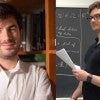
Rice researchers search for ultralight dark matter using a magnetically levitated particle
A new study led by Rice's Christopher Tunnell and Dorian Amaral sees the first direct search for ultralight dark matter using a magnetically levitated particle.
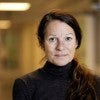
Rice recruits biophysicist to boost cancer research efforts
Rice’s Department of Chemistry will soon welcome Pernilla Wittung-Stafshede.
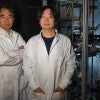
Physicists confirm elusive quantum spin liquid in new study
An international team of scientists led by Rice's Pengcheng Dai has confirmed the existence of emergent photons and fractionalized spin excitations in a rare quantum spin liquid.
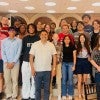
DUNE-TECH boot camp at Rice ignites next generation of America’s neutrino scientists
In a milestone moment for science education and collaboration, Rice hosted its first DUNE-TECH (DUNE Training ExperienCe Hub) camp this June, drawing students, researchers and scientists from across the country into the world of neutrino physics and computing.