
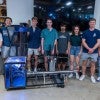
Rice students build low-cost cold spray metal 3D printer prototype
A team of Rice University students has developed a cold spray metal 3D printing device that relies on pressure and velocity rather than temperature to create a metal part.
Rice students build low-cost cold spray metal 3D printer prototype
A team of Rice University students has developed a cold spray metal 3D printing device that relies on pressure and velocity rather than temperature to create a metal part.

Faculty recognized with award for superior teaching
Nine Rice University faculty members received the 2024 George R. Brown Award for Superior Teaching, which honors top Rice instructors based on votes from alumni who graduated within the past two, three and five years.

Faculty, staff, students honored for excellence in teaching, mentoring, service
Each year, Rice honors members of the university community who have served students through outstanding teaching, dedication and service.

Study uncovers neural mechanisms underlying foraging behavior in freely moving animals
Rice neuroscientist Valentin Dragoi and team shed light on what happens in the brain of freely-moving macaques engaged in foraging behavior.

Rice bioengineers win $1.4M ARPA-H grant for osteoarthritis research
Bioengineers at Rice University have been awarded $1.4 million as part of a multi-center consortium funded by the Advanced Research Projects Agency for Health (ARPA-H) to develop strategies for reversing the effects of osteoarthritis.

Rice alumna wins prestigious merit-based fellowship for new Americans
Rice University alumna Minjung Kim is one of 30 recipients of the Paul & Daisy Soros Fellowships for New Americans, a merit-based graduate school program for immigrants and children of immigrants.

Duke-Makerere team claims first place in Rice360 design competition
A team of undergraduate students from Duke University and Makerere University won the top prize at the Rice360 Institute’s annual Global Health Technologies Design Competition as 24 international teams representing seven countries participated in the event April 12.

Rice engineering student builds Rice campus out of Lego pieces
Rice engineering student Andrew Linhart built a full scale model of the Rice campus using over 8,000 Lego pieces and help from his friends.

Rice’s Lane Martin elected as Materials Research Society fellow
Rice’s Lane Martin was elected a fellow of the Materials Research Society (MRS) “for seminal contributions to the science of ferroelectric and multiferroic thin film materials.”

First curved data link sidesteps key 6G wireless challenge
Researchers at Rice and Brown University have demonstrated the world’s first curved data link, an achievement that could revolutionize wireless communications.

2024 Huff Engineering Design Showcase winners announced
The Oshman Engineering Design Kitchen (OEDK), Rice’s premier undergraduate engineering makerspace, announced the winners of its annual Harrell and Carolyn Huff Engineering Design Showcase and competition, which took place April 11 at the Ion, during an award ceremony following the event.

Rice to offer new master’s in energy transition and sustainability
Rice University will launch a Master of Energy Transition and Sustainability (METS) program this fall designed to equip students with the tools needed to thrive in the evolving energy industry landscape.
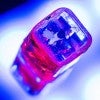
Rice team demonstrates miniature brain stimulator in humans
Rice engineers have developed the smallest implantable brain stimulator demonstrated in a human patient that could revolutionize treatment for drug-resistant depression and other psychiatric or neurological disorders.
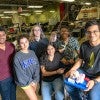
Rice engineering students’ device could make intubation safer for young babies
TinyTrach, a team of interdisciplinary engineering students from Rice, created an innovative pediatric endotracheal tube integrated with a camera and anchoring system that could make intubation procedures safer for babies 1 month and older by ensuring precise placement, stable anchoring and visibility access for up to 14 days.

Rice engineering students convert old truck into an electrical vehicle
Four teams of Rice engineering students converted a 1997 Chevy P30 delivery van into a fully electric vehicle in less than a year, using a combination of parts scavenged from out-of-use vehicles, custom-built elements and off-the-shelf items.