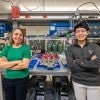
Rice professor Caroline Ajo-Franklin’s group, working in collaboration with researchers from Tufts University and Baylor College of Medicine, recently developed a flexible bioelectrical sensor system called electroactive co-culture sensing system (e-COSENS).
For Rice University junior D. Fitzgerald, what began as a personal journey of self-discovery has quickly grown into a powerful platform for advocacy — one now recognized across the city of Houston. Just one year after attending her first Pride Parade, Fitzgerald has been named a 2026 Houston Pride Parade Trendsetter Grand Marshal, an honor she says still feels surreal.
One team rose to the top of this year’s Veterans Business Battle: IntuBlade. Their win capped a competitive two-day event at Rice Business that brought together veteran entrepreneurs from across the country.
Kenneth Tam, an interdisciplinary artist whose work spans video, sculpture, installation, performance and photography, is an assistant professor of art.
Ten years after the 2016 Tax Day flood inundated parts of the Houston region with nearly two feet of rain in a matter of hours, new research from Rice suggests a similar storm today could have far greater consequences.
RBL LLC, a pioneering biotech venture creation studio dedicated to rapidly building companies based on breakthrough medical technologies, today announced the launch of Duracyte, a biotechnology company commercializing a pioneering class of implantable “biohybrid pharmacy” devices designed to produce therapeutic proteins continuously inside the human body.
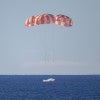
When NASA’s Orion capsule splashed down in the Pacific Ocean April 10, a critical piece of the spacecraft’s safe return traced back to research at Rice.
Rice Emergency Medical Services recently welcomed moulage artist Katie McKinney to campus for a hands-on workshop designed to enhance the realism of emergency response training. Through the use of special effects makeup, McKinney taught students how to recreate lifelike injuries — transforming standard simulations into immersive, high-impact learning experiences.