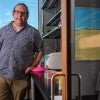
Rice University chemist Julian West is one of a dozen up-and-coming young scientists featured in Chemical & Engineering News’ (C&EN) 2024 Talented 12, an annual issue of the weekly news magazine that highlights rising stars across all chemistry research disciplines.
About 80 high school seniors from The Emery/Weiner School visited Rice University’s Joan and Stanford Alexander South Texas Jewish Archives (STJA) earlier this month for an educational program focusing on the history of refuseniks in the Soviet Union and the Houston Action for Soviet Jewry.
As Rice University rises among the nation’s elite institutions, it is now being recognized for its exceptional affordability. Rice was recently included onForbes’ inaugural list of “New Ivies,” celebrated for “turning out smart, driven graduates craved by employers of all types.” Now, new analysis by CNBC highlights Rice as the most affordable private school on this exclusive list.
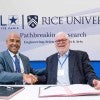
Rice University and Université Paris Sciences & Lettres (PSL) convened leading researchers for a daylong summit May 14 at the Rice Global Paris Center, following the official launch of a strategic research partnership between the two institutions.
The future of immigration and its relationship with this year’s election cycle was explored by experts at a May 14 event hosted by Rice University’s Baker Institute for Public Policy. Speakers from academia, media, legislature and immigration organizations surveyed how shifting policies have reshaped migration to the U.S.-Mexico border and discussed prospects for immigration reform.
A senior design team from Rice University’s George R. Brown School of Engineering was recently selected as one of four finalists for the IEEE Circuits and Systems Society (CASS) Student Design Competition.
A research team from Rice University led by Aryeh Warmflash has made strides in understanding the processes that guide human embryonic development. The group’s findings were published in the scientific journal Cells Systems May 15.
In Kathleen Canning ’s six years as dean of Rice University’s School of Humanities , she has made 50 faculty hires, overseen a faculty of 170, strengthened eight departments and managed 15 centers and programs, including several established under her leadership.
Seven alumni have been selected to serve on Rice University’s Association of Rice Alumni (ARA) Board of Directors: Sacha Abinader, Paula Desel, Tawfik Jarjour, Wayne Hale, June Marshall, Wanda Pan and John Sneider. They begin their three-year terms July 1, when David Leal becomes president-elect of the ARA and Cathryn Rodd Selman becomes an alumni trustee.
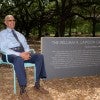
At the heart of Rice University’s campus lies The William A. Lawson Grove, a tribute to an esteemed civil rights champion and cherished community leader. Today, the Rice community mourns the passing of Rev. Lawson, who was 95 years old.
Konstantinos Mamouras, assistant professor of computer science at Rice, has won a National Science Foundation CAREER Award to create software tools to support the development of advanced Internet of Things applications.
The Shepherd School of Music at Rice University is proud to announce the appointment of Miguel Harth-Bedoya as its distinguished resident director of orchestras and professor of conducting, concluding an exhaustive international search and marking an exciting new chapter for its esteemed orchestra programs.
Rice University and Université Paris Sciences & Lettres, two of the world’s leading urban research and higher education institutions, announced Monday in Paris the signing of a strategic partnership for research and innovation on major global challenges and opportunities.