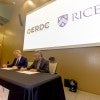
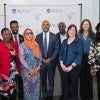
Rice and the United States Army Engineer Research and Development Center (ERDC) have signed an Education Partnership Agreement in formal recognition of their collaboration as part of Improving Access to Career and Educational Development (I-ACED).
Rice’s Santiago Segarra has won an NSF CAREER Award for his research on leveraging the structural properties of real-world data in order to boost AI effectiveness and utility.
Rice chemist James Tour was named to the National Academy of Engineering, one of the highest professional distinctions accorded “in recognition of distinguished contributions” to the field.
Rice University chemist Bruce Weisman’s three-decade career in nanocarbons research has been honored with the namesake award of the Rice colleague who founded the field and sparked Weisman’s interest in it.
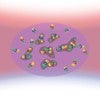
A team of Rice researchers mapped out how flecks of 2D materials move in liquid ⎯ knowledge that could help scientists assemble macroscopic-scale materials with the same useful properties as their 2D counterparts.
Houston Methodist and Rice recently launched the Center for Neural Systems Restoration, a joint interdisciplinary center for neuroscience research and treatment innovation that aims to advance care for neurological conditions by bringing together scientists, clinicians, engineers and surgeons to tackle medical challenges like stroke recovery and spinal cord injury.
Rice scientists have discovered a first-of-its-kind material, a 3D crystalline metal in which quantum correlations and the geometry of the crystal structure combine to frustrate the movement of electrons and lock them in place.
A new study by Rice researchers found that graphene derived from metallurgical coke, a coal-based product, through flash Joule heating could serve not only as a reinforcing additive in cement but also as a replacement for sand in concrete.
Rice University researchers in the lab of chemist Han Xiao have identified a promising new immunological pathway to treat stubborn bone tumors, one of most prevalent forms of metastases in breast cancer patients.
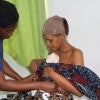
The Newborn Essential Solutions and Technologies (NEST360) international alliance launches Phase 2 of its mission to reduce newborn mortality in sub-Saharan Africa with $65 million in funding from the Bill & Melinda Gates Foundation, the Children’s Investment Fund Foundation, The ELMA Foundation, and generous individual contributions.
Rice’s Amanda Marciel has won an NSF CAREER Award for her research on materials useful in applications such as stretchable electronics and biomimetic tissues.
A major initiative to improve newborn care and survival across sub-Saharan Africa will announce the next phase of activities supported by new, eight-figure funding during a press conference held at Rice University’s Biosciences Research Collaborative Jan. 23.
Rice scientists along with collaborators at Durham University prolonged quantum behavior in an experimental system nearly 30-fold by using ultracold temperatures and special laser wavelengths to generate a “magic trap” that delays the onset of quantum decoherence.
Rice University and Woodside Energy today announced a ground-breaking five-year technology collaboration aimed at reducing greenhouse gas emissions and providing lower carbon solutions.
Rice scientists in the lab of Angel Martí have uncovered a new way to make high-purity boron nitride nanotubes, hollow cylindrical structures that can withstand temperatures of up to 900 degrees Celsius while also being stronger than steel by weight.