

Stitch by stitch, Rice sophomore found her way into French life
Adeline Thompson spent six weeks with her host family in Toulouse through Rice in France and came home seeing herself differently.
Stitch by stitch, Rice sophomore found her way into French life
Adeline Thompson spent six weeks with her host family in Toulouse through Rice in France and came home seeing herself differently.

Rice researchers develop new way to quickly recycle electronic waste
Rice’s James Tour recently published an improved method to recover antimony from this electronic waste stream.

Career awards showcase layers of excellence in Rice science department
Three Rice faculty members from the Department of Earth, Environmental and Planetary Sciences have recently been honored with career awards, showcasing excellence at every stage of career.
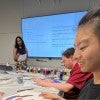
Rice graduate student starts club to help adults with intellectual and developmental disabilities
Graduate student Sayuri Jayawardena has started a Rice chapter of Lifelong Learning with Friends.

‘An investment in people’: Rice physics professor earns Packard Fellowship
Rice’s Yonglong Xie is one of 20 early-career scientists, mathematicians and engineers to receive a 2026 Packard Fellowship.

Rice’s Caroline Ajo-Franklin is part of an international research team funded by the United Kingdom’s Advanced Research and Invention Agency (ARIA), under its Universal Fabricator program.
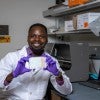
Rice scientists engineer new tool to improve detection of HIV and other viruses
Rice researchers have developed an improved version of Cas13a that could make it easier to detect HIV and other RNA viruses in blood and environmental samples.
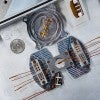
New monolithic ion trap developed for accessible quantum simulations
Rice’s Guido Pagano, along with collaborators at Duke University and Translume Inc., has developed a new kind of trapped-ion simulator, called a monolithic segmented 3D ion trap.
Rice launches transformational AI initiative with faculty hiring, new programs and facilities
Rice has launched a transformational universitywide AI initiative to recruit 75 faculty members working across disciplines, invest in a new, state-of-the-art facility that advances research and industry collaboration, and expand AI-related courses and degrees, accelerating the institution’s emergence as a global leader in advanced computing and responsible AI.
Improved precision microscopy method developed by Rice professor
Rice’s Anna-Karin Gustavsson published a method in Nano Letters expanding the use of light sheet microscopy to include a single objective in commercially available sample chambers.

Meet the 2026 Rice Global ambassadors: Karlianna Kapche
Time in Madrid and Paris changed how the biochemistry and psychology junior sees her future as well as her community at Rice.
Rice researchers find evidence of true polar wander
Rice researchers find evidence of movement in the Earth's spin axis 56-48 million years ago.
Rice researchers discover magnetic liquid crystal state in rare earth compound
In a recent study published in Physical Review X, Rice researchers showed YbMnBi₂'s magnetic spins prefer certain directions even when fluctuating.
A summer in Seoul reshapes premed student’s view of care
Through Rice in Korea, junior Abbie Wang shadowed traditional Korean medicine faculty alongside language coursework.

New catalogs map quantum possibilities of atomically thin materials
In two papers published in Science Sept. 24, an international collaboration provides both the building blocks and a guide to the search for families of twistronics.