Rice University has won a Phase I National Science Foundation grant to establish the NSF Center for Adapting Flaws into Features to investigate nanoscale chemical phenomena and optimize the structures and electronic properties of materials.
Rice University engineers have created microscopic seeds for growing remarkably uniform 2D perovskite crystals that are both stable and highly efficient at harvesting electricity from sunlight.
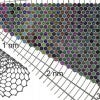
It's official: Hexagonal boron nitride (h-BN) is the iron man of 2D materials, so resistant to cracking that it defies a century-old theoretical description engineers still use to measure toughness.
New research suggests the jiggling motion of carbon nanotubes suspended in liquid solutions could have implications for the structure, processing and properties of nanotube fibers formed from those solutions.
With the imminent demolition of Rice University’s Abercrombie Engineering Laboratory, the space will soon be cleared for a new engineering and science building, according to Rice administrators.
International architecture firm Skidmore, Owings & Merrill (SOM) has been selected as lead architect for the new building. Houston’s Scientia Architects will consult on laboratory design.
There’s gold in them thar nanoparticles, and there used to be a lot of silver, too. But much of the silver has leached away, and researchers want to know how.
Nanomaterials researchers in Finland, the United States and China have created a color atlas for 466 unique varieties of single-walled carbon nanotubes.
The lab of physicist Junichiro Kono will share in a $1 million grant from the Chan Zuckerberg Initiative to improve imaging of proteins, cells and tissues.
Rice researchers continue to advance the science of single-molecule machines with a new lineup of nanocars, in anticipation of the next international Nanocar Race in 2022.
Nanophotonics researchers at Rice University, the Polytechnic University of Milan and the Italian Institute of Technology have demonstrated a novel technique for modulating light at terahertz frequencies with plasmonic metasurfaces.