
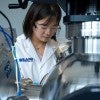
Room-temperature multiferroic could pave way to low-energy computing
Rice researchers engineered a new version of a well-known multiferroic that exhibits orders of magnitude higher performance at room temperature than its parent material.
Room-temperature multiferroic could pave way to low-energy computing
Rice researchers engineered a new version of a well-known multiferroic that exhibits orders of magnitude higher performance at room temperature than its parent material.

Scientists at Rice pioneer faster, greener method to recycle lithium-ion batteries
As global demand for lithium-ion batteries continues to surge, a team of Rice researchers has developed a faster, more energy-efficient way to recover critical minerals from spent batteries, potentially easing supply chain pressures and reducing environmental harm.

Faculty, staff, students honored for excellence in teaching, mentoring, service
Each year, Rice honors members of its community who have served students through outstanding teaching, dedication and service.
‘Perfectly symmetrical’ 2D perovskites boost energy transport
Rice scientists have created a new type of 2D semiconductor that comes closer than ever to a “perfect” crystal.
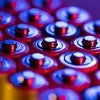
Plasma and lemon juice: Milder method retrieves nearly 95% of critical minerals in battery waste
A 15-minute plasma pretreatment helped recover lithium, cobalt, nickel and graphite from spent lithium-ion batteries, pointing to a lower-chemical, lower-energy approach to recycling.

Boron arsenide semiconductor sets record in quantum vibrations
A new Rice study reports an unusual quantum coherence of phonons in cubic boron arsenide, a semiconductor with promising electronic and thermal properties.

Thorny issue plaguing lithium-ion batteries laid bare in new study
Lithium-ion batteries could improve thanks to Rice researchers’ unprecedented measurements of lithium dendrites’ stiff, brittle behavior.

Granular activated carbon-sorbed PFAS can be used to extract lithium from brine
James Tour and his research team developed a process to use PFAS to extract lithium from high-salinity brine pools in a study recently published in Nature Water.
New technique spots hidden defects to boost reliability of ultrathin electronics
Researchers at Rice have shown that hard-to-spot defects in a widely used two-dimensional insulator can trap electrical charges and locally weaken the material, making it more likely to fail at lower voltages.

Diamond owl swoops in with new method to keep electronics cool
A Rice research lab’s signature keepsake helped perfect a method for growing patterned diamond surfaces that could help decrease operating temperatures in electronics by 23 degrees Celsius.
Metabolic clues emerge from new molecular map of Alzheimer’s
Rice scientists have developed the first complete, label-free molecular atlas of the Alzheimer’s brain in an animal model.

Rice joins national team studying how energy moves through materials
Rice materials scientists Boris Yakobson and Ming Tang are part of a multi-university team selected for a Multidisciplinary University Research Initiative award from the Office of Naval Research.

Researchers at Rice produced graphene by replicating Edison's 1879 light bulb experiments.

Rice researchers awarded Hill Prize in Engineering for light-driven ammonia synthesis
Rice’s Naomi Halas, Peter Nordlander and Hossein Robajatzi have been awarded the 2026 Hill Prize in Engineering for their work advancing light-driven technologies for sustainable ammonia synthesis.

Rice Brain Institute awards first seed grants to jump-start collaborative brain health research
The Rice Brain Institute has announced the awardees of its first funding initiative, a seed grant program that is a collaborative effort between the university and four institutional partners in the Texas Medical Center.