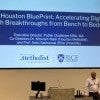
Rice’s Office of STEM Engagement, the Houston Methodist-Rice Digital Health Institute and Houston Methodist are launching a three-year program that equips Houston-area high school and community college students and the teachers who serve them with practical skills in biomedical hardware and artificial intelligence for health.
Rice's César A. Uribe is developing computational tools to help scientists better understand ecosystems with recent studies using AI to glean new insights from different kinds of ecological data — from African mammal food webs to tropical forest soundscapes.
Researchers at Rice and collaborators have developed a wireless network of miniature bioelectric implants that could transform treatment for heart failure, spinal cord injury and other chronic conditions. The system would integrate with patient anatomy easier than conventional medical implants, eliminating the need for batteries and invasive wiring.
After more than a decade of outstanding leadership at Rice, Paul Cherukuri, the university’s top innovation executive, will be leaving his post to accept a position at the University of Virginia.
Rice’s campus was buzzing this summer as students in the Rice Emerging Scholars Program wrapped up six weeks of challenging courses, hands-on projects and community-building. The end-of-program events and presentations marked the culmination of a summer designed to prepare incoming first-year students — particularly those from under-resourced high schools — for the pace, depth and rigor of STEM majors at Rice.
Across the country and globe, Rice students are seizing hands-on roles with real stakes by interning in fields as diverse as offshore energy, arts education, global sports marketing and refugee housing.
Rice’s Lei Li wins NSF CAREER Award to develop a new generation of wearable medical imaging technology capable of visualizing deep tissue function in real time.
Researchers at Rice and collaborators at Oak Ridge National Laboratory and the University of Technology, Sydney report the first demonstration of low noise, room-temperature quantum emitters in h-BN made through a scalable growth technique.
Rice researchers and collaborators have developed a new cavity design that selectively enhances the quantum vacuum fluctuations of circularly polarized light in a single direction, achieving chirality — a feat that typically requires the use of a strong magnetic field.