

Rice team brings home top prize in 2024 Ethics in Engineering Case Competition
A team of Rice engineering students have won this year’s national Ethics in Engineering Case Competition hosted by Lockheed Martin.
Rice team brings home top prize in 2024 Ethics in Engineering Case Competition
A team of Rice engineering students have won this year’s national Ethics in Engineering Case Competition hosted by Lockheed Martin.

Rice group helps improve support device for end-stage heart failure
Rice’s Joseph Cavallaro and his team are part of two multi-institutional projects that have won grants from the Department of Defense (DOD) and the NIH, respectively, to develop and optimize new left ventricular assist devices (LVADs).

Ken Kennedy Institute hosted 17th annual Energy High Performance Computing Conference
The Ken Kennedy Institute at Rice hosted the 17th annual Energy High Performance Computing Conference on March 5-7 at the BioScience Research Collaborative, welcoming over 560 guests to Rice from 30 states and 11 countries.

U.S.-Latin America ‘policy lab’ could leverage AI as arena for international collaboration
Rice experts weighed in on a public hearing of the National Artificial Intelligence Advisory Committee (NAIAC) on the risks, opportunities and potential ways to leverage artificial intelligence as an arena for international collaboration between the U.S. and Latin America.

Rice’s Nai-Hui Chia wins NSF CAREER Award
Rice computer scientist Nai-Hui Chia has won a National Science Foundation CAREER Award to develop a new theoretical framework to facilitate the development of efficient quantum algorithms for a range of problems in quantum physics and computer science as well as enhance the security of quantum cryptography.

Data-processing tool could enable better early stage cancer detection
A team of Rice researchers has developed a tool that is better at integrating single-cell DNA and RNA data than more recent, state-of-the-art technologies. The findings could lead to better early stage cancer detection.

Rice joins federal consortium on AI safety
Rice has joined the nation’s leading artificial intelligence stakeholders to participate in a Department of Commerce initiative to support the development and deployment of trustworthy and safe AI.

Widely used machine learning models reproduce dataset bias in Rice study
Rice researchers found two machine learning models widely used for immunotherapy research did not correct for bias present in the publicly available data used to train the models, which appears to favor higher-income populations.

Rice Online Master of Computer Science program cracks top 15 in US News rankings
Rice University’s Online Master of Computer Science Program leaped 13 spots in the latest edition of U.S News & World Report’s Best Online Programs rankings, announced today.

Rice’s James Tour named to National Academy of Engineering
Rice chemist James Tour was named to the National Academy of Engineering, one of the highest professional distinctions accorded “in recognition of distinguished contributions” to the field.
Rice Biotech Launch Pad startup Motif Neurotech closes Series A financing of $18.75 million
Rice University today announced that Motif Neurotech, a neurotechnology developing minimally invasive bioelectronics for mental health formed through the Rice Biotech Launch Pad, closed an oversubscribed Series A financing round of $18.75 million.

Rice’s Ashok Veeraraghavan wins Texas Academy’s O’Donnell Award
Rice’s Ashok Veeraraghavan has been awarded the Edith and Peter O’Donnell Award in Engineering from the Texas Academy of Medicine, Engineering, Science and Technology (TAMEST), one of the state’s highest academic honors.
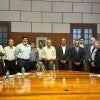
Rice announces strategic collaboration agreement with Indian Institute of Science
As part of its strategic global initiative, Rice University leadership recently traveled to the Indian Institute of Science (IISc) where the two institutions agreed to collaborate to develop shared research and industry engagement around the themes of data science, energy and materials.

Rice to host International Workshop on AI-Powered Space
Rice’s AI Houston Institute, in collaboration with NASA, will host the two-day International Workshop on AI-Powered Space, covering the latest advances in artificial intelligence (AI) theory and practice in core space and extended space at the university’s tech hub, the Ion.

Annual SSPEED Center conference welcomes international flood-control experts
The Severe Storm Prediction, Education and Evacuation from Disasters (SSPEED) Center at Rice hosted its 11th annual conference last month at the university’s Anderson-Clarke Center.