
In 1977, a 27-year-old woman sat wired to monitors that recorded her heartbeat and brain waves for a gold-plated record bound for interstellar space. She thought about falling in love. She also thought, on purpose, about suffering and injustice, the very things the record had been curated to leave out.
The woman was Ann Druyan, creative director of the Golden Record that NASA sent aboard its twin Voyager spacecraft. Having learned of the earliest audio recording of warfare, made on the Western Front in 1918, she wanted to complicate the record’s polished portrait of humanity. Houston artist Dario Robleto builds “Ancient Beacons Long for Notice,” the last film in his Golden Record trilogy, around that story.
The film screens free Nov. 6 at 7 p.m. in the Moody Center for the Arts’ Lois Chiles Studio Theater, in partnership with Rice University’s Space Humanities Initiative. Jennifer L. Roberts, the film’s co-writer and Harvard University’s Drew Gilpin Faust Professor of the Humanities, and Alexander Regier, Rice’s William Faulkner Professor of English and an initiative co-leader, will lead a Q&A with Robleto. They will also discuss “The Heartbeat at the Edge of the Solar System: The Golden Record and Our Search for Connection,” which Robleto and Roberts will publish with Scribner in 2027, the record’s 50th anniversary.
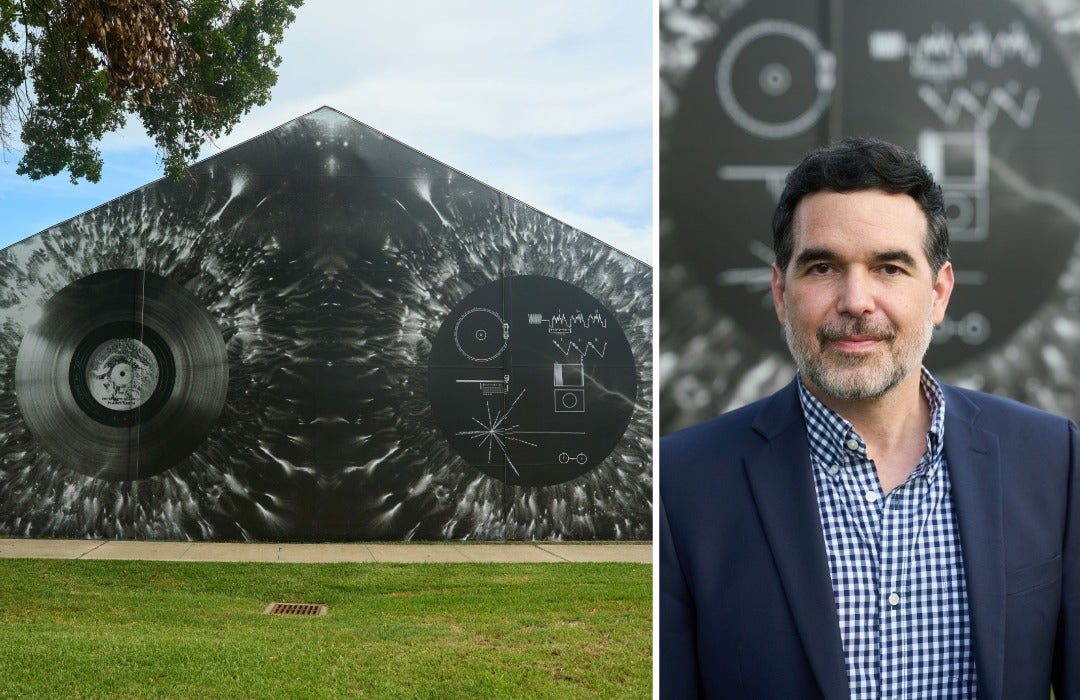
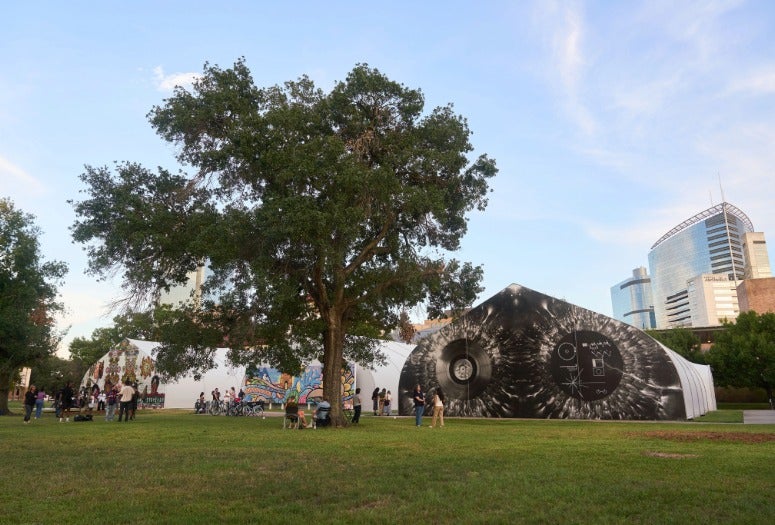
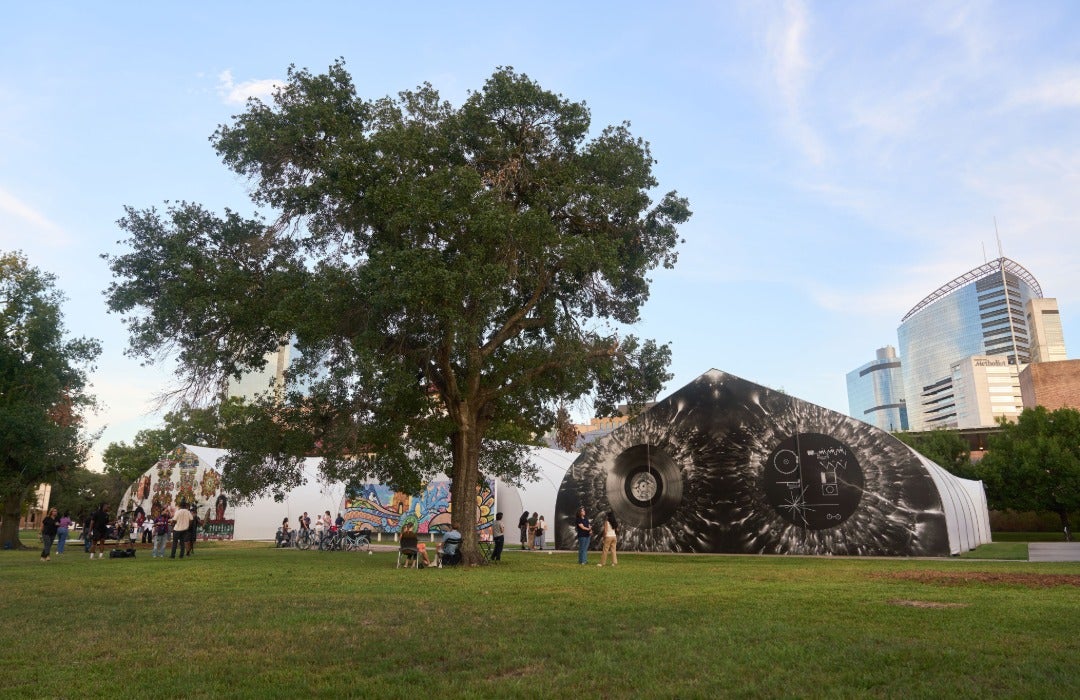
Twelve days later, NASA expects Voyager 1 to become the first human-made object to reach one light-day from Earth, about 16.1 billion miles away. On campus, a still from the film covers one of the PCF Tents along Loop Road near Wiess College as part of the Moody’s Tent Series, on view through July 31, 2027.
“I hope viewers will treat the piece as a meditative exercise on one of humanity’s oldest questions: Are we alone? ... Art is one of our greatest tools for addressing this question, and we continually invent ways to let each other know we are not alone,” Robleto said.
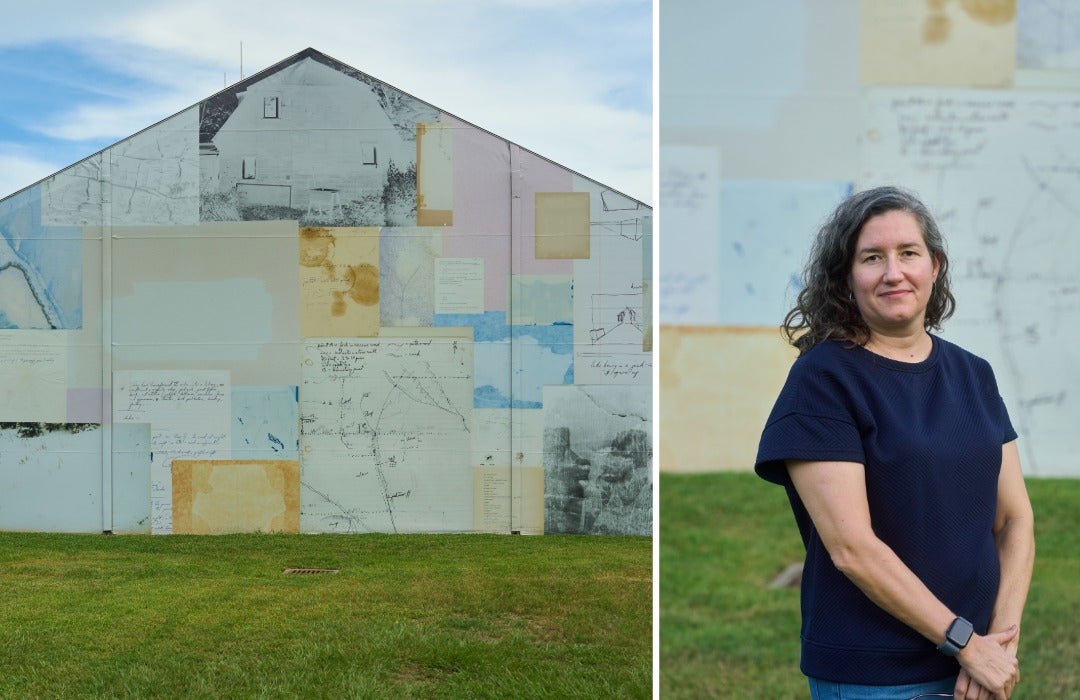
The two murals beside it start closer to home in family archives. Keliy Anderson-Staley, a professor of photography and video at the University of Houston, draws on one from the off-grid Maine homestead where she grew up, pairing her father’s letters and drawings with decades of her own photographs.
Her installation “Wilderness no longer at the edge of things” works in two parts. By day, the tent shows a collage from that archive, including her father’s hand-drawn map of the property. After sunset, it becomes a screen for a video tracing the family cabin from its construction in the late 1970s to 2019, when new owners burned it.
“It is worth watching at dusk as the video seems to slowly emerge from the collage — ghostly at first and then so you can finally only see the slightest lingering traces of the vinyl documents through the video,” Anderson-Staley said. “A friend who watched it with me said it was like watching memories coming back to you.”
Anderson-Staley also noted the contrast of a cabin built without running water, projected within sight of the Texas Medical Center’s towers and helicopters.
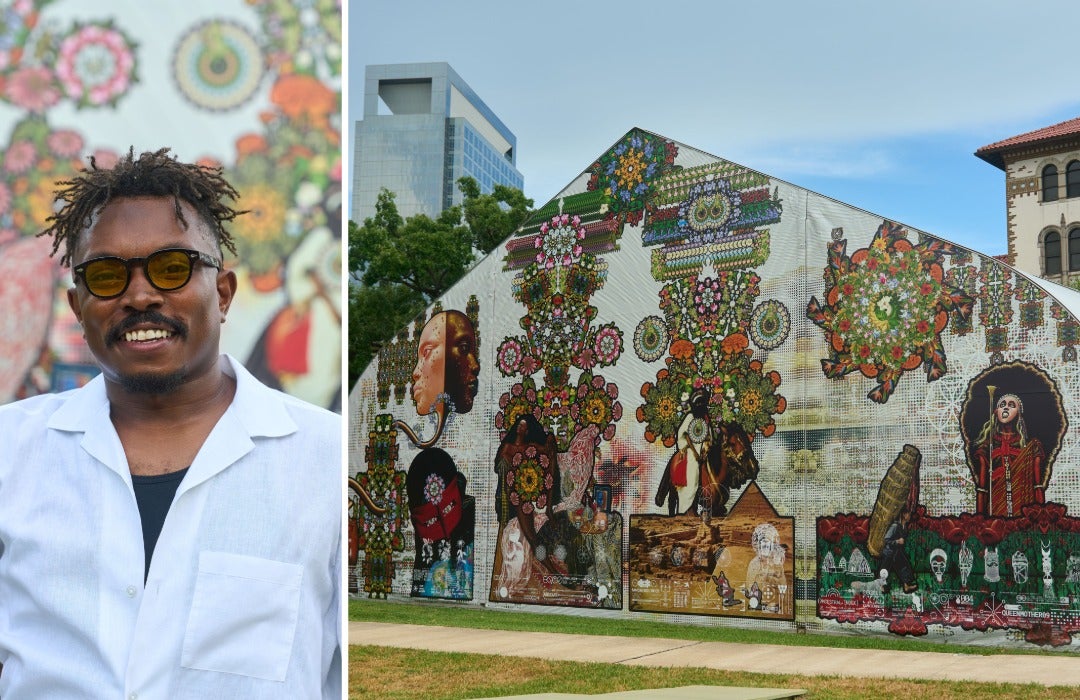
Preston Gaines, a Houston artist and architect, fills the third tent with “Floral Modulo,” four connected fields of archetypal figures. A masked woman from a National Geographic photograph stands in for his late mother; a figure from Mati Klarwein’s cover art for Miles Davis’ “Bitches Brew” stands in for his daughter. Black-eyed Susans, marigolds and cherry blossoms, chosen in part for Houston’s Black, Latino and Asian communities, frame the fields and spill onto the lawn as three steel sculptures.
“At its core, I think the work is about how we carry the people, images and histories that shape us while still making space for change, renewal and becoming,” Gaines said.
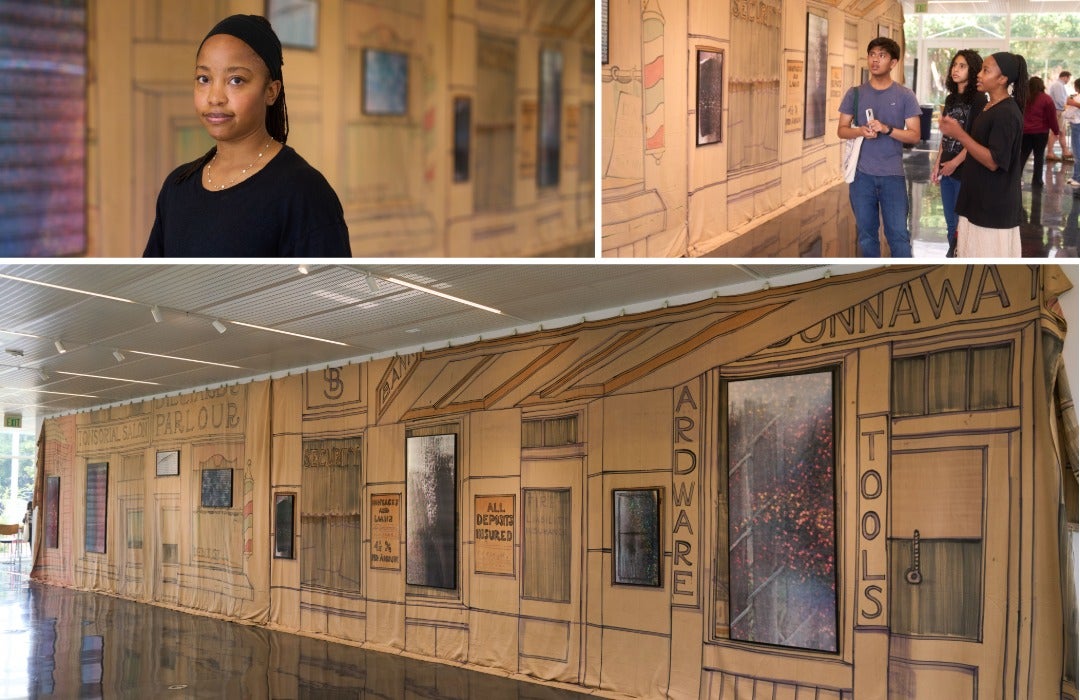
Off the Wall, the Moody’s partnership with the Core Residency Program at the Glassell School of Art, Museum of Fine Arts, Houston, commissions Core alumni to create yearlong installations in Brochstein Pavilion. This year, Steffani Jemison, a Brooklyn-based artist and associate professor at Rutgers University, mounted “Untitled (Same Time / black bird)” across a reclaimed theatrical backdrop of a generic American main street. Eight lenticular prints along its storefronts draw on her research into the spikes, reflective ribbon and decoys people use to keep birds away. It remains on view through Sept. 11, 2027.
“I hope the installation invites viewers to reflect on the physical space of the Brochstein Pavilion alongside questions of community, belonging, including and othering,” Jemison said. “As I made it, I considered the many dimensions of the transparent, the artificial and the true, especially in the context of a campus community.”
Jemison is drawn to the contradictions in those devices: Birds often ignore the shimmering ribbon meant to scare them off, while the same flashes of color draw people in. Several prints cite a 1917 Audubon Society publication on Texas birds, including the grackle, a species so at home around people that it is often treated as a nuisance.
Each print changes as a viewer walks past, and no single spot reveals the whole wall. Seeing it means doing what the deterrents were built to make birds do: keep moving.
Both series belong to Rice Public Art, which the Moody curates and manages, as temporary counterparts to its permanent collection. The collection recently reached 100 works with Danish artist Jeppe Hein’s “Social Spaces for Rice University,” a four-part commission of twisting lampposts, looping benches and a swing set between Chao and Lovett colleges. Visitors can find all 100 on a self-guided tour through the Rice Public Art app, which students built with the Moody.
Learn more about the Tent Series and Off the Wall on the Moody’s website.