
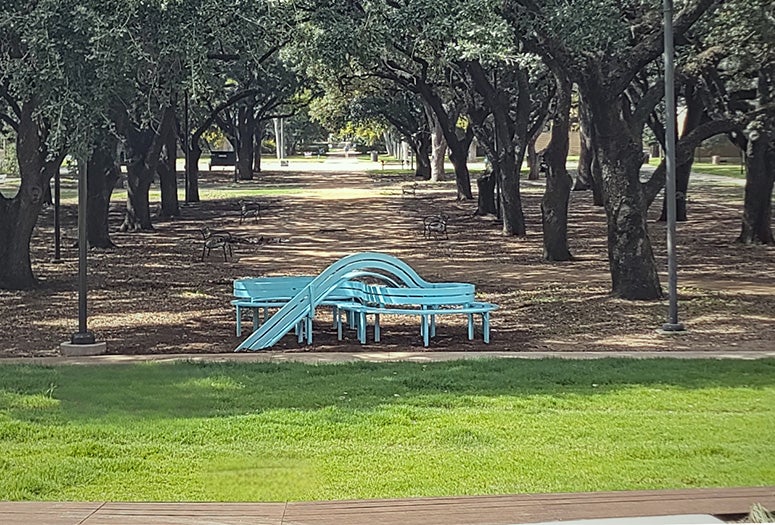
Intertwining lampposts, acrobatic benches and a swing set blooming from the ground comprise the 100th work in the Rice Public Art Collection. Situated between Rice’s two newest residential colleges, “Social Spaces for Rice University” is a four-part commission by Danish artist Jeppe Hein and marks a milestone for the permanent collection.
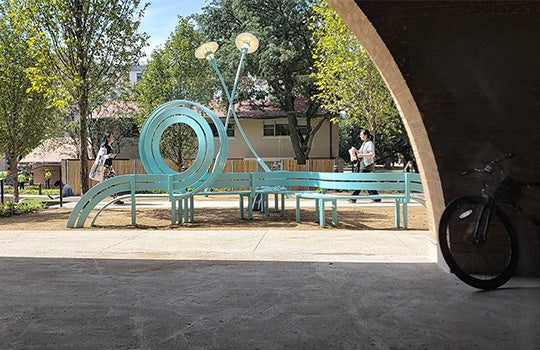
“The Moody has grown the collection by more than 60 works in nine years,” said Joel Thompson, deputy director and divisional lead at the Moody Center for the Arts, which curates and maintains the collection. “It’s exciting and fitting that Jeppe’s commission marks the 100th work. We can celebrate this milestone where students live while highlighting a selection of artworks that reflect Rice’s global profile and ambition.”
The sculptures sit between Chao and Lovett colleges where nearly 600 students live, dine and cross paths daily. The colleges were designed by the Danish firm Henning Larsen, which puts a second Danish sensibility on that corner of campus.
Through form and color, the installation gives everyday objects a life of their own. Lampposts twist around one another like figures in a dance. Two benches rise, dip and loop as if animated by their social purpose. Powder-coated in a vibrant turquoise, these mundane elements take on playful personalities that announce themselves from across the walkway.
Luis Duno-Gottberg, the Lee Hage Jamail Professor of Latin American Studies and founding magister of Chao College, was on site as the sculptures were delivered and installed. He described the meticulousness of the installation and the artist’s investment in making the space inviting as a privilege to witness.
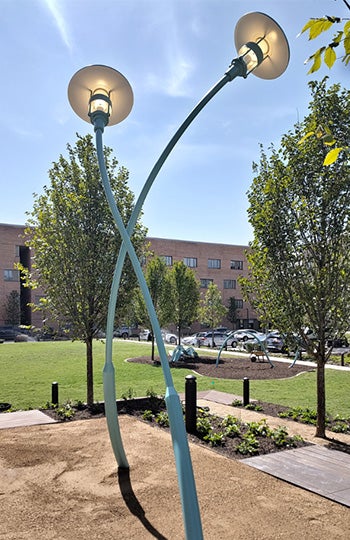
“Whether by chance or design, everything about the piece seems to connect beautifully with Chao: its color palette, its openness and especially its playful, joyful spirit,” Duno-Gottberg said. “It already feels less like an object placed outside the college and more like something that belongs to the life of the community.”
Though whimsical, the objects Hein created retain their practical purpose. The lampposts provide light for the adjacent path. The benches offer a seat for a resting student. What he alters is our relationship to public art and public spaces. Hein’s sculptures are considered unfinished until the public arrives and contributes their attention and play. For two decades, he has maintained this practice from modified benches installed in city parks worldwide to breathing exercises staged for thousands of participants at once, thereby generating mental well-being.
“Hein’s work makes the social fabric of Rice one of the installation’s essential materials, highlighting how public art can both emerge from and contribute to the experience of university life,” said Claudia Mattos, associate curator at the Moody.
The Moody weighs every proposed acquisition against the site it would occupy, the gaps it would fill in the collection, the disciplines and communities nearest to it and the students who will pass it daily for four years.
“Rice stands apart in the close relationships that can emerge between works of art and the disciplines, communities and spaces that surround them,” Mattos said.
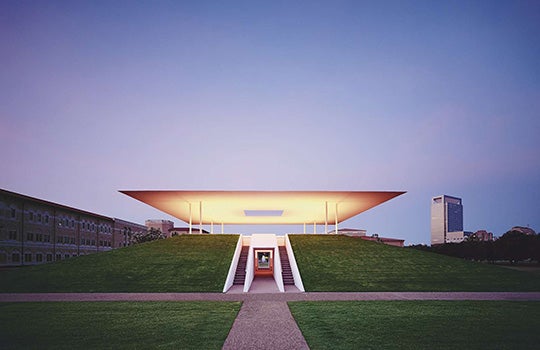
The evidence is scattered across campus. James Turrell’s “Twilight Epiphany,” engineered for acoustics beside the Shepherd School of Music, works as both artwork and performance venue. Rafael Lozano-Hemmer’s “Climate Parliament” in the O’Connor Building for Engineering and Science uses 481 interactive speaker-lights to play recordings of scientists, scholars, activists and students discussing climate change as people move through the building. Likewise, Rice faculty Natasha Bowdoin’s “Flower Power” in the MD Anderson Biological Laboratories reflects the study of life in all its complexities. Hein’s commission extends the Rice Public Art Collection’s intention to be responsive to the campus setting by encouraging student social life where it is most likely to occur.
“The architecture of the new colleges reflects a holistic consideration of student life, elevating every space, and the art sited there had to be just as thoughtful,” said Lee Clark, senior director of exhibitions at the Moody. “Like the dining hall or study areas in the buildings, Jeppe’s sculptures have a purpose that is only realized when students make them their own.”
Rice established its public art initiative in 2008, which makes the collection young by the standards of the institutions it now sits beside. It spans the university’s 300-acre campus and includes work by Michael Heizer, Shirazeh Houshiary, Beverly Pepper, Sol LeWitt, Ursula von Rydingsvard, Carmen Herrera, Dorothy Hood, Charles Gaines and Leo Villareal. Art & Object called it one of the “most rigorous world-class permanent collections of public art in the country” and credited Rice with a near even split between women and men artists that older programs are still working toward.
All 100 works in the collection invite consideration of the history, research, community and creative thinking that make Rice an exceptional university. Discover them on your self-guided tour, enabled by the Rice Public Art app, which was built by students in collaboration with the Moody.