
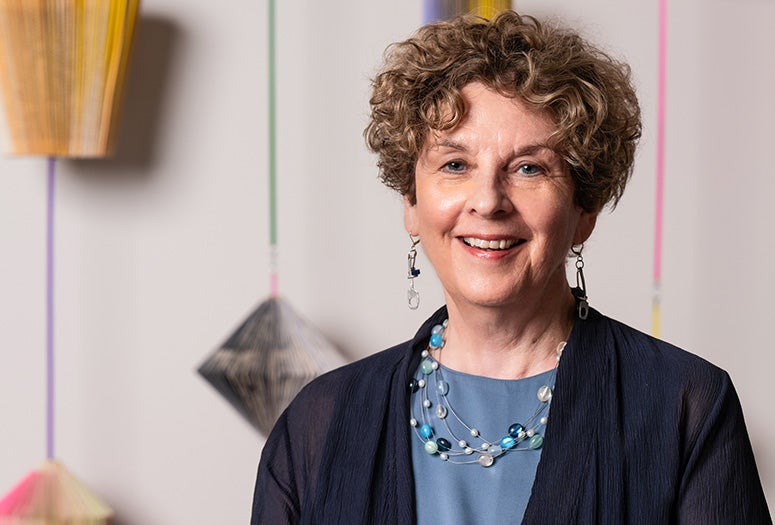
In her first semester as dean of Rice University’s School of Humanities, Kathleen Canning sat in a classroom and let the faculty do the talking. It was one of eight listening sessions across her first two semesters, roughly 20 faculty at a time, with Canning and then-associate dean Lora Wildenthal in the back while colleagues filled whiteboards: what was most exciting, where the school was stuck, what had never been tried.
Canning had told the search committee that she would not arrive with a prefabricated vision. A freestanding school of humanities was unfamiliar territory for a scholar who had only known comprehensive schools of arts and sciences. A vision worth having, she believed, had to be developed on the ground.
Canning will conclude her second term as dean of the School of Humanities and Arts at the end of the spring 2027 semester, closing almost a decade of leadership at Rice that began in January 2018. In that time, the school hired 70 faculty members, founded a new department, opened a new arts building, launched a new graduate degree, adopted a new name and rebuilt its research center. Ask her what any of it was about and she does not start with buildings. She starts with people.
“Unlocking potential — of a school, of its faculty — sounds graceful, as if you just take the key and open the door,” Canning said. “Except it is extremely complex because unlocking potential means empowering people to do what they do best, to build something new, to collaborate or connect in new ways across academic boundaries, which are very resilient structures.”
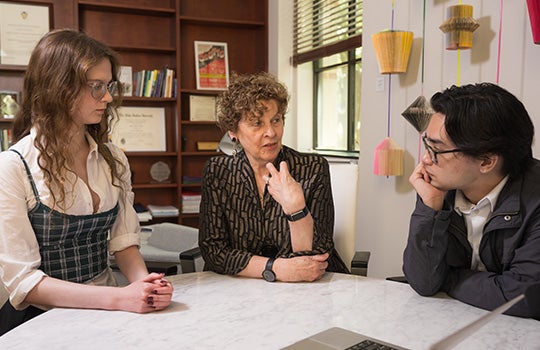
Empowering people, in Canning’s practice, meant knowing them. An anonymous comment in her fourth-year review noted that no previous dean had learned every staff member’s name; she had. She turned up at faculty and guest lectures and readings, at art openings and exhibitions and tracked various problems the staff faced, making sure that they were addressed in due time.
Several of the school’s biggest changes under her watch show how the approach worked.
The first is the faculty itself. The 70 new hires, most of them assistant and associate professors, came from top doctoral and MFA programs in the United States and abroad, a generational renewal of the humanities and arts at Rice. Their work strengthened programs in medical humanities, environmental studies and politics, law and social thought while inspiring the founding of a new interdisciplinary media studies program and undergraduate major.
The second is the arts, both visual art and creative writing, an elevation that culminated in the renaming of the school in 2025 as the School of Humanities and Arts. In 2021, Canning pushed for a cluster hire that added three tenure-track faculty to the Department of Art while also advocating for the new student arts building. She made the case the way a historian would — with years of student exit reports pulled from Rice’s own records. The numbers were unambiguous: Art was already the school’s second-largest major. The hires were followed by approval of the construction of Susan and Fayez Sarofim Hall, the 94,000-square-foot home for the Department of Art that opened in September 2025 and completed the campus arts district alongside the Moody Center for the Arts and Brockman Hall for Opera. Last month, Niche ranked Rice’s arts program No. 2 in the country for a second consecutive year.
Creative writing followed the same logic. English is the school’s largest major and two-thirds of its students concentrate in creative writing. Canning backed the faculty’s vision and rising student demand with a run of hires that faculty describe as a once-in-a-generation group, and that growth led to the creation of a fully funded, three-year Master of Fine Arts in Creative Writing program, which welcomed its first cohort this fall.
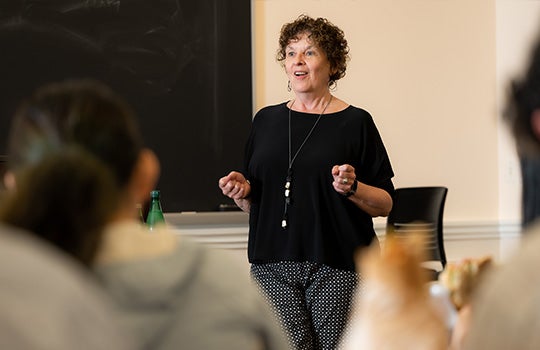
A third is the reinvigoration of existing structures to raise their impact and open access to them. The Department of Transnational Asian Studies, founded in 2021 in close conjunction with the Chao Center for Asian Studies, is one example. The Humanities Research Center is another. Canning heard in the listening sessions that the center remained distant for many faculty across the school’s eight departments, 10 programs and seven centers. When the director’s term concluded, she declined to immediately name a successor. Instead she convened a faculty council across departments and ranks that met monthly, consulted humanities center directors from other universities and worked through how to make humanities and arts research more visible, accessible and impactful at Rice and beyond.
“The new director was a participant in that two-year process. We all agreed that we didn’t want one person to come in and put their stamp on this and have it be theirs,” Canning said. “We sought instead a hub of intellectual activity and collaboration that is available to and open to the entire school.”
The center is now a hub of connective interdisciplinary humanities and arts research which serves as home for postdoctoral and MFA fellows and hosts vibrant graduate and undergraduate student affiliates.
Betting on the harder road is nothing new for her. After earning her first degree at the University of Oregon, Canning went to Germany as a Fulbright Scholar and earned a master’s degree at Heidelberg University with a thesis of over 100 pages written in German. Working in Berlin archives, she seriously considered staying. She applied to American doctoral programs with one condition: She would go only if fully funded because she still carried student debt from Oregon and Wisconsin. Johns Hopkins University admitted her to its history doctoral program with a full fellowship. She finished in 5 1/2 years, went on to her first teaching position in the renowned University of Michigan history department, where she earned tenure and promotion, and eventually became chair of the department (the largest in the country). Michigan’s strong interdisciplinary culture and deep commitment to leadership training prepared her for the exciting next steps at Rice.
What comes next is a return to the life she paused in 2018. Canning has sabbatical banked and a book she set aside to become dean. She will return to her study of citizenship and the founding of democracy in Weimar Germany, which ultimately collapsed in the face of the Nazi rise to power. It has not lost its relevance, she said. Canning looks forward to her archives and her library, to travel abroad and to time to spend with her family in Michigan and New York.
Asked what she hopes for the school, Canning points to the momentum that the humanities and arts have built over the past decade and the work it will require to carry its connective capacities to the next. The new visibility of the humanities and arts at Rice was hard-earned, and she said she hopes the school keeps its claim to a place at every table on campus. She also hopes that its excellent research and course offerings reach more Rice students and that the faculty own what they built and protect it as higher education faces harder years ahead. The stakes, Canning said, reach beyond one school.
“Humanities leadership requires continued innovation and openness to change,” she said. “These last years the humanities are most often associated with crisis and contraction. At the same time, the prolonged crisis of democracy and the rise of AI have highlighted the vital, even urgent role of the humanities in advancing students’ critical and creative capacities.”
Unlocking potential, in her telling, is only the first step. Protecting what grows from it is recurring work.
“You can unlock and support the growth and building of beautiful things, and as a historian, I know how difficult it is to assure that they will continue,” Canning said. “Stewardship of this beautiful thing could not be more important.”