HOUSTON – (Oct. 13, 2020) – Rice University researchers are expecting high election turnout in Harris County, with a majority of voters heading to the polls during early voting, more ballots cast by mail and a significant decline in the number of voters going to the polls on Election Day.
Rice marine geologist and oceanographer André Droxler knows Charles Darwin's theory about atoll formation is incorrect, and Droxler and former Rice postdoc Stéphan Jorry are hoping to set the record straight with a comprehensive new paper about the subject.
Collaborative National Science Foundation grants will use data from internet balloons to study atmospheric gravity waves and their influence on the weather and climate.
With physical distancing a requirement for classes and other campus activities, Rice students have been taking full advantage of the fall weather and moving their study sessions outdoors whenever possible. (Photos by Jeff Fitlow)
How iconic are senior executive chef Roger Elkhouri’s cinnamon rolls? So iconic that there’s a hue named for his sweet treats in the new Rice Color Walk public art installation outside Hanszen College.
HOUSTON – (Oct. 8, 2020) – The Ion has been awarded $1.4 million in federal funding for a partnership with NASA's Johnson Space Center (JSC) and DivInc to create its Aerospace Innovation Hub (ASCI-Hub) – which will support and develop regional minority business enterprises (MBEs) that address aerospace-related challenges.
What makes a team effective? A new book from a Rice University psychologist examines that question and identifies ways leaders can foster successful organizations.
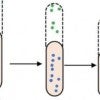
A primal mechanism in bacteria that keeps them in their personal Goldilocks zones -- that is, just right -- appears to depend on two random means of regulation, growth and division, that cancel each other out. The same mechanism may give researchers a new perspective on disease, including cancer.
Aquamarine, emerald, garnet, zircon and topaz are but a few of the crystalline minerals found mostly in pegmatites, veinlike formations that commonly contain both large crystals and hard-to-find elements like tantalum and niobium. Another common find is lithium, a vital component of electric car batteries.
HOUSTON – (Oct. 6, 2020) – The tent-like structures serving as temporary classroom spaces at Rice University during the pandemic could have been left as they were built: tall, steel-framed, silvery-white facilities tucked behind a row of live oak trees near Hanszen College at the corner of College Way and Alumni Drive.
Rice alumnae Elisa Arango, Susannah Dittmar, Lauren Payne and Sanika Rane are finalists in the Collegiate Inventors Competition sponsored by the National Inventors Hall of Fame for their Universally Friendly Obturator, a customizable device developed at the Oshman Engineering Design Kitchen that simplifies radiation therapy for patients with cervical cancer.