
Rice nears goal of $20M faculty matching fund, $3M remains to unlock full impact
Rice nears goal of $20M faculty matching fund, $3M remains to unlock full impact.
Rice nears goal of $20M faculty matching fund, $3M remains to unlock full impact
Rice nears goal of $20M faculty matching fund, $3M remains to unlock full impact.
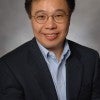
Rice professor awarded Harvard Radcliffe Fellowship
Rice professor Qimiao Si has been awarded a Harvard Radcliffe Fellowship for the 2026-27 academic year.

‘There truly is no place like Rice’: Arjun Surya shares commencement address
‘There truly is no place like Rice’: Arjun Surya shares commencement address.

Digital Learning Symposium emphasizes responsible AI in education
The 2026 Digital Learning Symposium, an inaugural event for Rice, brought together faculty, students and thought leaders to explore a central question shaping higher education today: How do we preserve human-centered learning in an age increasingly defined by artificial intelligence?
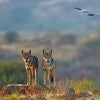
Indian and Tibetan wolves found to have important, ancient genetics
Rice professor Lauren Hennelly uncovers stories hidden inside the DNA of Indian and Tibetan wolves.

Moody Awards for Outstanding Poster Presentation recognize 5 undergraduate research presentations
Undergraduate researchers at the Wiess School of Natural Sciences recently presented their findings at the annual Natural Science Undergraduate Research Symposium (NSURS). Of the over 300 students that participated, five were awarded for an outstanding poster presentation.

From campus classrooms to commencement stage: Rice faculty, staff celebrate their own graduates
As more than 1,360 students crossed the stage at Rice during the university’s largest undergraduate commencement ceremony in history, the celebration at Rice Stadium was especially personal for a number of faculty and staff members watching from the stands — and in several cases, standing on stage to hand their own children a diploma.

ARUBA Weekend celebrates legacy, charts future for Black alumni at Rice
Legacy at Rice is not just something to look back on — it is something actively built, carried and expanded. That idea that started with a few members of the Association of Rice Black Alumni led by past ARUBA president Angela Berry Roberson came into focus during the inaugural ARUBA Weekend, a recent four-day gathering that brought together alumni, students, faculty and university leaders for reflection, reconnection and a shared vision for what comes next.
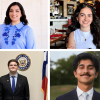
Four Rice students named 2026 Sumners Scholars.
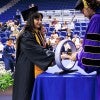
Nearly 300 graduates of the George R. Brown School of Engineering and Computing took part in the induction ceremony for the Order of the Engineer and The Pledge of the Computing Professional.

Blackett named third-ever women’s track and field, cross country head coach
Rice Vice President and Director of Athletics Tommy McClelland announced on Tuesday that Andrea Blackett '97 has been named the third-ever head coach for the women's track and field/cross country program. Blackett will take over the program effective on July 1, following the retirement of longtime head coach Jim Bevan.
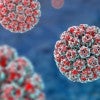
Rice researchers develop realistic ‘mock’ samples to speed cervical cancer test development
A team of Rice bioengineers has developed a new way to create highly realistic “mock” patient samples that could help accelerate the development of faster, more accessible cervical cancer screening tests for low-resource settings.
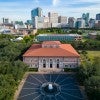
The Institute of Global Politics at Columbia University’s School of International and Public Affairs and the Baker Institute for Public Policy at Rice announced the creation of a new task force focused on assessing the strategic rationale for U.S. foreign assistance, reframing policy objectives and developing actionable recommendations for a new era of global competition.
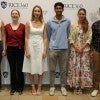
Rice360 graduation breakfast honors excellence in research, service and global innovation
The Rice360 Institute for Global Health Technologies hosted its annual Recognition and Awards Breakfast, honoring the 2026 graduates of Rice’s global health technologies minor program May 8.

New Rice professor leads project to build more climate-resilient Gulf Coast
Andrew Hoffman, an incoming professor of Earth, environmental and planetary sciences who will join Rice’s faculty July 1, was awarded a $1.9 million grant to improve the accuracy, actionability and regional relevance of sea level rise projections.