
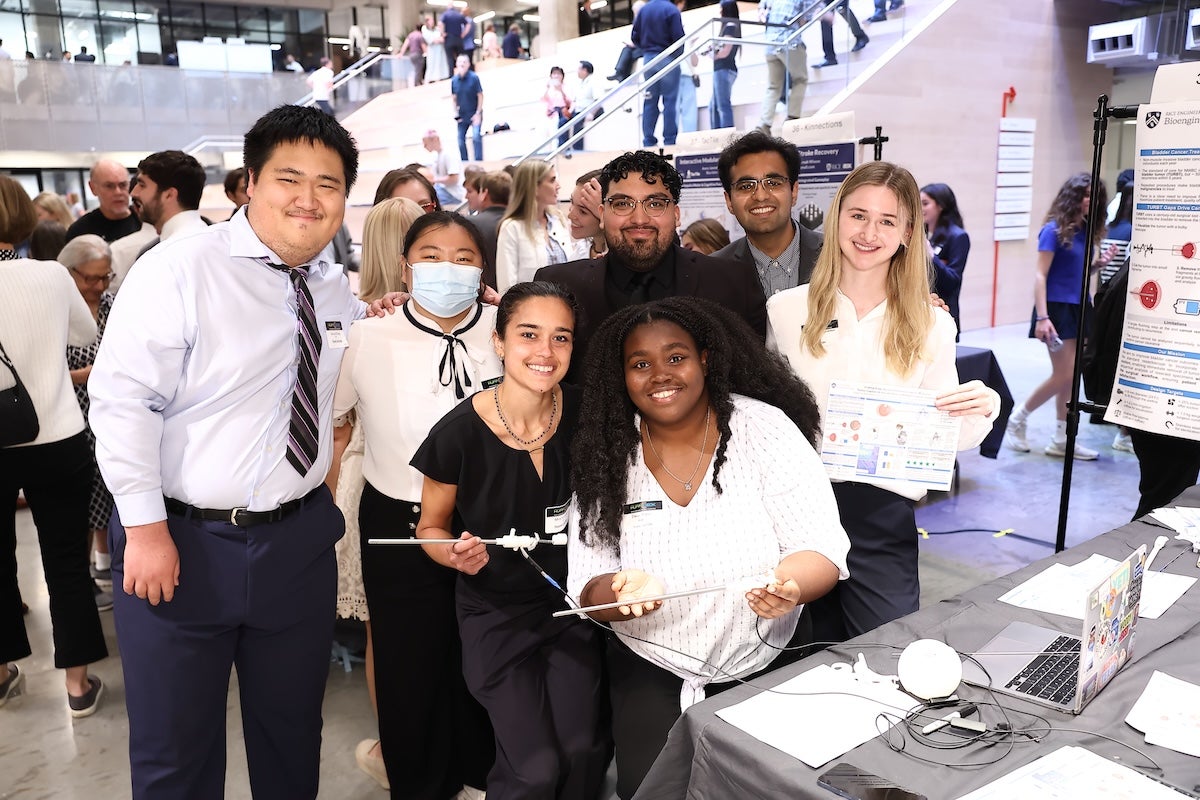
Team UroVac won the top prize at Rice University’s Huff OEDK Engineering Design Showcase April 16 at the Ion, earning the $5,000 Woods-Leazar Innovation Award for its device designed to improve bladder cancer surgery. The event featured nearly 400 students across 75 teams, supported by 95 judges, faculty, alumni and industry partners.
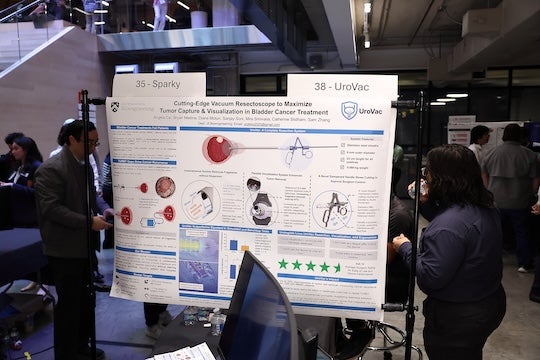
The award recognizes the team’s Complete Bladder Tumor Resection and Intravesical Closure Device, which seeks to address the high recurrence rates of bladder cancer associated with current treatment methods. This project focuses on improving tumor removal and reducing complications during surgery, targeting a significant challenge in bladder cancer care.
Team members include Rice seniors Angela Cai, Diane Moturi, Sanjay Soni, Mira Srinivasa, Catherine Stidham, Sam Zhang and team leader Bryan Medina.
“We’ve built a tool to improve people’s lives and their outcomes in surgery,” Medina said. “Our goal was to give patients a better chance at a higher quality of life.”
The OEDK Showcase highlights the importance of student-led engineering in addressing complex health challenges with implications that could extend well beyond the classroom, said Sabia Abidi, an assistant teaching professor of bioengineering and the faculty mentor for UroVac.
“The event underscores how student projects can meet real-world medical needs and contribute to innovation in patient care,” Abidi said.
Addressing a persistent medical challenge
The project began when Samit Soni, a urologist with Memorial Hermann Health System, presented the problem to students at the start of the design cycle. Soni described how existing tools often fragment tumors, allowing pieces to spread within the bladder and increase recurrence rates.
“As urologic cancer surgeons, we have accepted the current subpar method of piecemeal bladder tumor removal surgery for too long,” Samit Soni said. “We are long overdue for a better state-of-the-art solution to help reduce bladder cancer recurrences in the future.”
The team initially considered designing a tool to remove tumors in a single piece but ultimately shifted to a design that incorporates suction to remove cancerous fragments during surgery. This approach aims to limit dispersion while maintaining a minimally invasive procedure.
Bladder cancer affects about 80,000 people in the United States each year, according to the National Cancer Institute. The standard procedure, transurethral resection of bladder tumor, or TURBT, has recurrence rates as high as 70% within five years, according to the National Library of Medicine. Repeat procedures are common due to incomplete tumor removal and the reseeding of tumor cells.
Engineering a new approach
The team redesigned the resectoscope, the primary tool used in TURBT procedures, to improve precision and efficiency. Their device reduces the diameter of the instrument while integrating a digital camera, irrigation system and suction mechanism.
Using computational fluid dynamics simulations and physical prototypes, the students optimized fluid flow to balance irrigation and suction. Irrigation maintains visibility during the procedure, while suction removes tumor fragments in real time.
Additionally, they incorporated a damper system to enhance surgeon control, addressing limitations in existing tools that lack motion resistance.
The device remains in the prototype stage and will require federal approvals and further development before it can be used clinically.
“It has the potential to reduce the number of recurrences,” Medina said. “That has been our biggest driver and motivation.”
Looking ahead to clinical use
The team’s work has also been recognized nationwide. UroVac won first place at a national Design of Medical Devices competition in Minnesota, reinforcing confidence in the project’s potential.
Medina said the team focused on solving a real medical problem rather than pursuing awards. He added that further development could help reduce repeat surgeries and improve patient outcomes.
“This process was rigorous, but Rice prepared me well for it,” Medina said. “The faculty was engaging and supportive, and I am incredibly grateful for my team. There’s only so much one person can do, but together, we were able to create something beautiful.”