
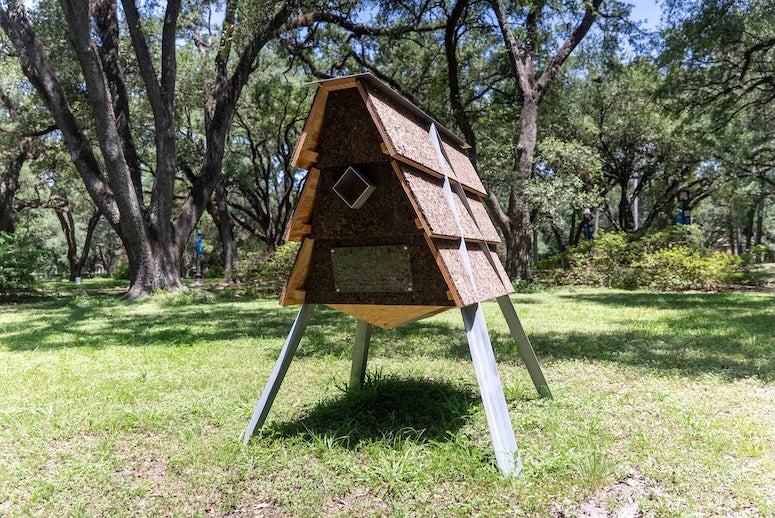
Visitors to Rice University may have noticed some new sights at Gate 1: a collection of student and faculty-built creations that, together, make up the “Sustainable Ecologies Installation.” This outdoor installation is part of Rice’s programming for the FIFA World Cup celebrations. The installations, led by lecturer David Abraham from the Wiess School of Natural Sciences, invites Houston residents and visitors alike to reflect on the art and science of sustainability.
Each installation was designed and developed by Rice students and faculty. Industry advisory experts were selected from local, national and international sustainability leaders including Rice alum Sarah Hussain ’18, head of environment for FIFA. Each installation asks the viewer to engage with the natural world around them.
“Many of us walk past oak trees every day without realizing how many organisms rely on them for food, shelter and survival,” said Qihang Li, an architecture graduate student who co-designed and built the “Living Oak Communities” installation. “I hope people leave ‘Living Oak Communities’ with an appreciation for the complexity of the natural world that exists right around them.”
For Li, the project also represents months of learning and adapting to the challenges of taking a project from conception to design to installation.
“For a long time, this piece existed only as sketches, drawings and digital models,” he said. “The experience taught me how different a project becomes when it moves from drawings and digital models into physical reality. Design is not only about ideas but also about materials, tools and the process of making.”
“The Entanglement Pavilion,” designed and built by Humaira Shaikh, Wenxuan Xie, Sarai Huaman, Osvaldo Salgado, Ege Ozruna and Janset Yeten, is also inspired by trees, but it seeks to connect this inspiration with Houston itself.
“I was drawn to the project because it asked the question how can a structure honor the place it came from?” said Shaikh, an architecture undergraduate student. “The installation became a way to translate ideas about Houston’s climate and ecology into something people could physically utilize instead of simply read about.”
The installations, situated in the oak tree grove at Rice’s front entrance, convey a theme of collaboration and curiosity. Installations will remain in place until the end of September, allowing for the Rice campus community to share in the experience.
“This project required a lot of effort from everyone involved, and I am proud of what we were able to build together,” said Ozruna, an architecture undergraduate student. “It was a challenging process, but it was also very rewarding to see our ideas become a real space that people can use and experience.”
“It was really cool to work on a project celebrating the World Cup,” said Fife Akinyanmi, an undergraduate student majoring in math and computer science who worked on “Digital Ecologies.” “This Cup has been the most exciting one yet, especially with the new tournament format bringing even more eyes to the game than ever before, and I’m happy that I got to help Rice show some of that excitement too.“
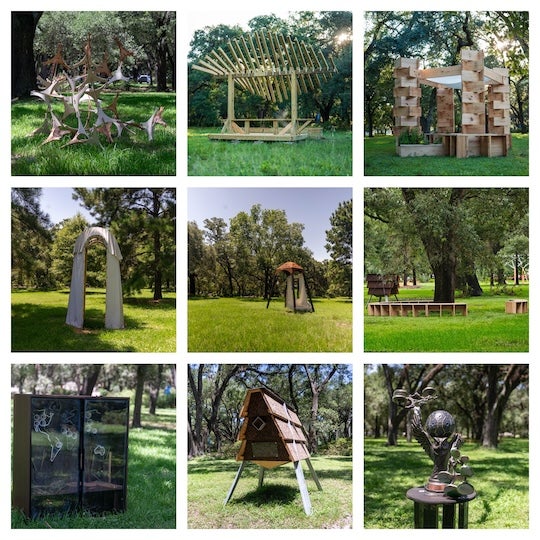
Second row: Interference, Canopy of Reflection, Live Oak Communities
Third row: Insect Hotels, Oak Keeper Granary, unnamed owl statue
‘Sustainable Ecologies Installations’
‘Digital Ecologies’
Robert Likamwa, Lauren Gold, Qianyu Ma
“Digital Ecologies” combines student-authored digital media with light projection mapping and distributed display systems, transforming ecological themes into public-facing art installations across Gate 1 and under Lovett Hall’s Sallyport.
‘Entanglement Pavilion’
Wenxuan Xie, Sarai Huaman, Osvaldo Salgado, Ege Ozruna, Humaira Shaikh, Janset Yeten
“Entanglement Pavilion” centers the ecological and social aspects of sustainability. Inspired by the metaphor of the tree, the installation invites visitors to pause beneath the oaks, touch nature with friends and share culture and feeling in a flexible public room.
‘Sustainable Pavilion’
Eduarda Quintana Favero, Chase Foster, Ava Garrelts, Benjamin Roa
“Sustainable Pavilion” is a multipurpose outdoor classroom and gathering space. Its curved wood roof and recycled water-resistant fabric create cooling shade while redirecting rainfall into an adjacent native plant garden.
‘Live Oak Communities’
Qihang Li, David Abraham, Scott Egan
“Live Oak Communities” frames Rice’s live oaks as living infrastructure: habitat, cooling canopy, public room and scientific archive. The installation pairs fabricated plywood bench modules, grove-scale seating arcs, layered ground graphics and interpretive ecology content, so visitors can sit within the grove while learning how gall wasps, parasitoids, leaves, acorns and understory communities connect across the tree canopy.
‘Insect Hotels’
Anika Gupta, Minji Munoz, GSA Sustainability Committee
“Insect Hotels” combines small-scale habitat architecture with public education. Layered cavities, wood textures and planting zones support pollinators and invite visitors to see insects as collaborators in urban ecology.
‘Oak Keeper Granary’
Ian Ting
“Oak Keeper Granary” invites people to think like caretakers of the live oak ecosystem. It uses the acorn as a small object with a large story: food, seed, memory and future canopy.
‘Canopy of Reflection’
Luis Torres Juarez
“Canopy of Reflection” uses mirrored or luminous surfaces to make visitors aware of the canopy above and the community around them. The work links cooling shade with personal reflection.
‘Interference’
Luis Torres Juarez
“Interference” treats sustainability as a pattern of overlapping forces. Visitors encounter layered lines and shifting visual fields that suggest climate, circulation, signal and disturbance.
‘Clouds of Wings’
Tianyi Bo, Liufei Zhu, Harper Bo and Yiyi Yang
"Cloud of Wings" imagines the campus as a threshold for flight and gathering. Repeating wing forms hover overhead, shifting with light and inviting visitors to read the sky as part of the installation.