
LumiStrain, a Rice University spinout commercializing a Strain Sensing Smart Skin (S4) for structural testing and health monitoring, has received a $1.55 million award through the National Science Foundation’s Small Business Innovation Research Fast-Track program. The highly competitive program supports only 15 companies nationwide in translating NSF-supported scientific and engineering discoveries into commercially viable products.
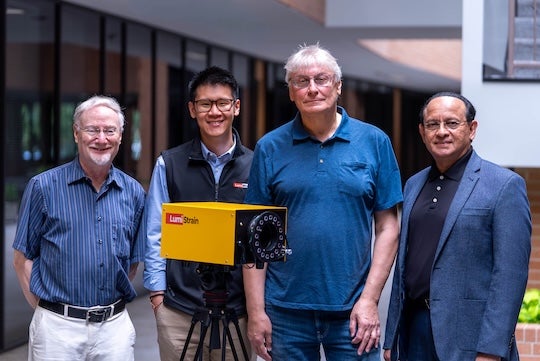
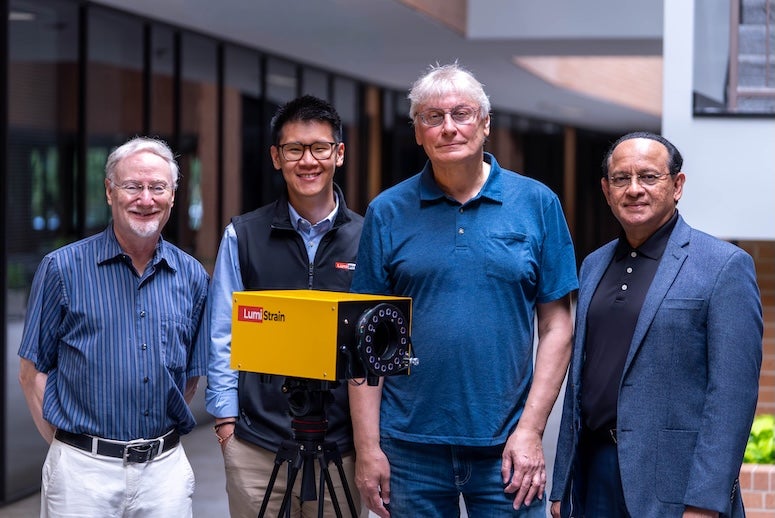
LumiStrain is commercializing technology developed at Rice by chemistry professor Bruce Weisman, civil and environmental engineering professor Satish Nagarajaiah and research scientist Sergei Bachilo, licensed through the university’s Office of Technology Transfer. Rice alum and Activate Fellow Wei Meng, who worked on the technology during his graduate studies and was lead author on a key publication, now serves as the company’s CEO.
The company’s S4 technology combines an ultrathin carbon-nanotube sensing film with a noncontact optical imaging system to produce high-resolution, full-field strain maps. By revealing how strain is distributed and accumulated across a structure, this technology can help engineers identify localized stress concentrations, detect early stage damages, optimize maintenance and prevent structural failures.
The Rice team conducted its first on-site demonstration at Airbus’ Aerospace Integrated Research and Test Centre in the United Kingdom in 2023. In 2025, its sensor was used during an Airbus A220 airframe certification test. The NSF Fast-Track award will support further product development, customer validation and preparation for broader commercial deployment.
“We are incredibly excited to receive the NSF SBIR Fast-Track award,” Meng said. “This award recognizes the potential of the technology we have spent years developing at Rice and gives us the resources to put our system in the hands of more engineers. By making full-field strain measurement faster and more accessible, we hope to enable safer, smarter and more efficient testing and monitoring of critical structures.”